
Find the Right Market Report
Search thousands of industry reports, market insights, and research studies in one place.
Search thousands of industry reports, market insights, and research studies in one place.


iCare, part of the Revenio Group, and the U.S.-driven eye health innovation organization EyeCheq, have entered into a collaborative agreement and strategic minority investment to increase access to point-of-care eye screening via the deployment of EyeCheq stations in the United States. The collabration goal to speed up the acceptance and accessibility of automated screening services and the development of AI-driven diagnostics.
EyeCheq stations are intended for busy and easily accessible environments, like labs and pharmacies located in retail stores, occupational health hospitals, and primary medical care facilities. The stations incorporate the iCare DRSplus fundus imaging device in addition to other ophthalmic tools. Imaging outputs are reviewed by Eyecheq's network of licensed eye care doctors, involving optometrists and ophthalmologists. The stations are available in many languages to confirm accessibility for various populations. Screened patients receive a targeted report within 24 hours, allowing rapid and high-quality screening for diabetic retinopathy, glaucoma, age-related macular degeneration, and other vision-associated conditions.
In line with the spending, EyeCheq announced the appointment of John Floyd, VP of U.S. Sales, to its Board of Directors, further aligning the two companies at the governance level as they speed up joint commercial and healthcare initiatives.
"We want to be a pioneer in creating eye-health solutions that combine top-level technology, artificial intelligence, and patient-centered care. We are already conducting pilot deployments of EyeCheq stations in the United States with several key partners. The partnership strengthens the position of iCare and our devices in the U.S. vision screening and eye care market. EyeCheq stations are a highly scalable concept that brings screening into non-traditional environments closer to people's everyday lives - places where they already go. With our innovative solutions, we improve the quality of clinical diagnostics and cost-effectively streamline patient care pathways, while conserving society's limited professional resources", says Revenio CEO Jouni Toijala.
"Our partnership with iCare represents a shared commitment to transforming access to eye care," said Dr. Rashid Taher, CEO of EyeCheq. "Together, we're removing traditional barriers to screening by putting cutting-edge diagnostic technology directly into easily accessible settings for communities that need it most. We are seeing the automation of the iCare imaging devices as a key part of the successful adoption of our platform in primary care and retail settings, which have tremendous potential to scale."
More than 530 million patients live worldwide with diabetes, over a third of whom are at challenges of vision-threatening diabetic retinopathy. Glaucoma, age-associated macular degeneration, and uncorrected refractive challenges contribute mainly to global visual impairment. The collaborative services by EyeCheq and iCare bring advanced-quality screening closer to those who need it creating sight-saving screening more accessible than ever.
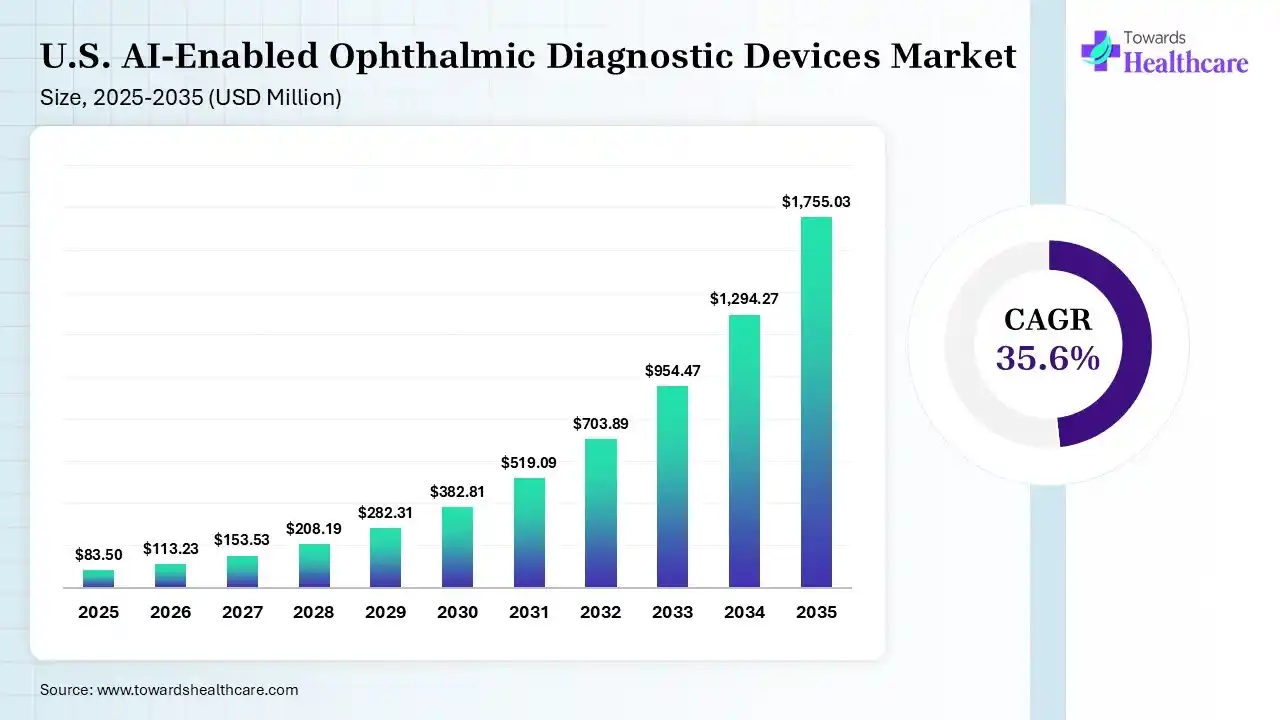
According to Towards Healthcare, the U.S. AI-enabled ophthalmic diagnostic devices market is projected to grow significantly, with estimates indicating the market size will increase from USD 113.23 million in 2026 to approximately USD 1755.03 million by 2035, expanding at a CAGR of 35.6% from 2026 to 2035. AI-driven technology has the potential to transform screening programs and increase access to eye care by allowing automated disease identification and remote diagnostic support. A major milestone in AI-based adoption in ophthalmology is the regulatory approval of autonomous AI technology for diagnosing diabetic retinopathy from retinal images. Artificial intelligence (AI) has rapidly evolved from an experimental computational concept to a significant healthcare tool in multiple medical specialties. AI-based technology improves ophthalmology management, enhances patient outcomes, and optimizes healthcare workflows. AI-based technology continues to evolve; its influence on ophthalmology increases beyond diagnostics. Emerging technologies are shaping the future of ophthalmic care, providing novel opportunities to improve treatment accuracy and accessibility.
Revenio is a worldwide player in eye care diagnostics and vision care technology services operating globally. The Revenio Group provides a comprehensive portfolio of diagnostic tools, imaging services, refraction solutions, software, and workflow technology serving the requirements of optometry, optical retail, and ophthalmology. Revenio's ambition is to build more linked and effective eye care diagnostic workflows by offering eye care professionals rapid, simple-to-use, and reliable service for the diagnosis and monitoring of glaucoma, retinal diseases, and various eye conditions. Revenio's solutions support eye care professionals worldwide by enhancing diagnostic effectiveness, healthcare workflows, and quality of care through the patient journey.
A recent report by Towards Healthcare highlights that the U.S. AI-enabled ophthalmic diagnostic devices market is growing, as AI-based technology provides momentous improvements in ophthalmic information management, disease screening and monitoring, challenge prediction and early warning systems, medical resource allocation, and health awareness and patient management. These development substantially enhances the quality and effectiveness of medical care, specifically in preventing and managing prevalent eye conditions like cataracts, diabetic retinopathy, glaucoma, and myopia. AI offers significant improvements in ophthalmic data management, disease screening and monitoring, risk prediction and early warning technology, healthcare resource allocation, and health education and patient management. E-medicine and mobile applications have increased access to medical care services and improved the capabilities of primary medical care providers.
Speak with a healthcare analyst about your research, consulting, or platform needs.