
Find the Right Market Report
Search thousands of industry reports, market insights, and research studies in one place.
Search thousands of industry reports, market insights, and research studies in one place.
The US dental 3D printing market is predicted to grow from USD 1259.16 million in 2026 to USD 7770.2 million by 2035, driven by a CAGR of 22.41%.


The U.S. dental 3D printing market size was estimated at USD 1028.64 million in 2025 and is predicted to increase from USD 1259.16 million in 2026 to approximately USD 7770.2 million by 2035, expanding at a CAGR of 22.41% from 2026 to 2035. The market is experiencing strong growth, driven by the rapid adoption of digital dentistry, increasing demand for customized dental restorations, and expanding use of chairside 3D printing technologies. Advancements in printing materials, software integration, and streamlined digital workflows are further improving treatment efficiency, precision, and patient outcomes across dental clinics and laboratories.
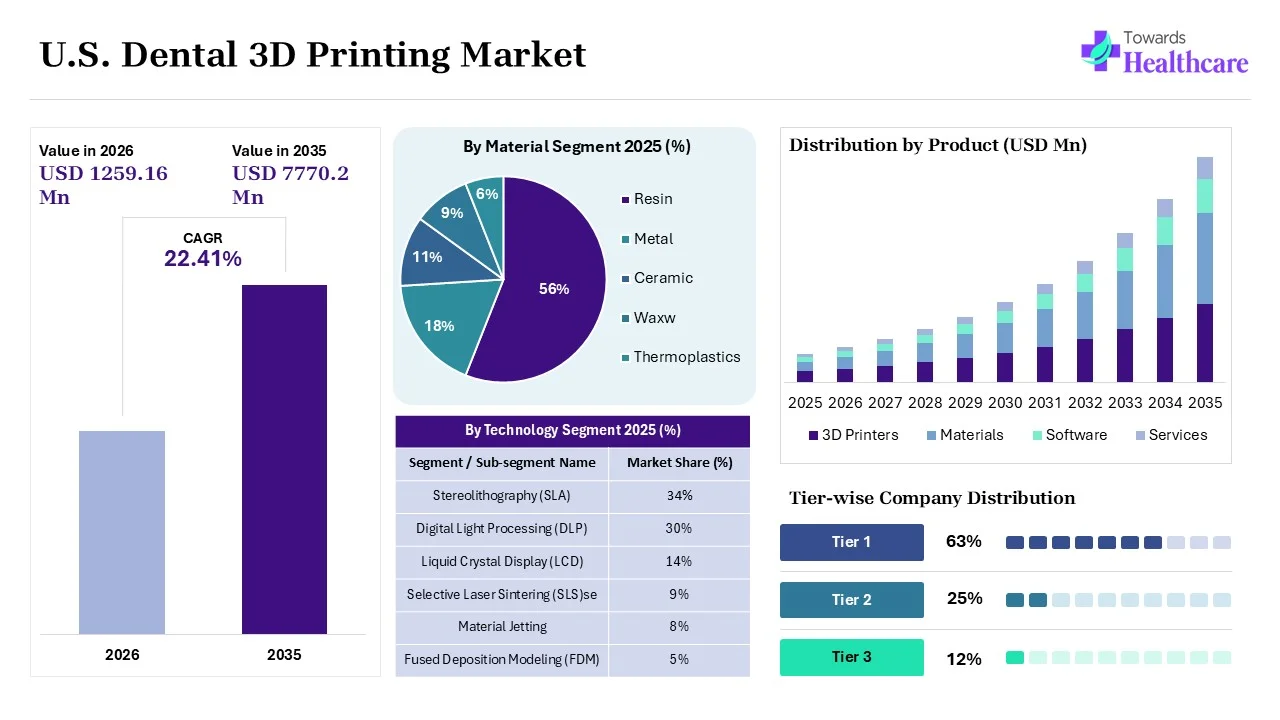
Dental 3D printing additive manufacturing technology is used to produce precise patient-specific dental models, crowns, bridges, dentures, aligners, surgical guides, and other dental devices from digital designs. The U.S> dental 3D printing market due to the rising adoption of digital dentistry, increasing demand for customized dental restorations, and expanding use of chairside 3D printing systems. Technological advancements in printers, biocompatible materials, and CAD/CDM software are improving treatment accuracy and production efficiency. Growing investments by dental clinics and laboratories are further accelerating market expansion.
The U.S. dental 3D printing market is expected to expand steadily as dental providers increasingly adopt fully digital workflows and in-house manufacturing. Continued improvements in printing speed, material performance, and workflow automation will enable faster, more precise, and personalized dental care. Growing investment in digital dentistry and advanced restorative solutions is expected to create new opportunities across clinics, laboratories, and research institutions.
| Dental Disease/Condition | Population Group | Percentage |
| Dental Caries | 20-64 | 90 |
| Untreated Dental Caries | 29-64 | 21 |
| Dental Caries (treated or untreated) | 2-19 | 46 |
| Untreated dental caries | 5-19 | 13.2 |
| Complete tooth loss | 65+ | 13.2 |
The high prevalence of dental caries and tooth loss across different age groups highlights the growing need for advanced restorative and prosthetic dental treatments in the U.S. This increasing disease burden is accelerating the adoption of dental 3D printing technologies for producing customized crowns, bridges, dentures, implants, aligners, and surgical guides with greater precision and shorter turnaround times.
The 3D printers segment held a dominant share of 39% in 2025 due to increasing adoption of in-house digital manufacturing by dental clinics and laboratories. Advanced dental 3D printers enable rapid production of customized crowns, bridges, dentures, aligners, surgical guides, and dental models, with high precision. Continuous improvements in printing speed, accuracy, and workflow efficiency further strengthened the segment’s leading market position.
The stereolithography (SLA) segment dominated the market with a share of 34% in 2025 because it delivers outsourcing precision and consistent quality for dental applications. It is widely used to manufacture accurate dental models, surgical guides, aligners, and temporary restorations. Its reliable performance, material compatibility, and ability to streamline laboratory and chairside workflows continue to support its market leadership.
The crowns & bridges segment dominated the U.S. dental 3D printing market with a share of 23% in 2025, owing to the increasing need for customized tooth restoration procedures. Dental professionals are adopting 3D printing to achieve greater precision, reduce turnaround times, and improve restoration quality. The growing prevalence of tooth decay, damaged teeth, and aging populations has further accelerated demand for this application segment.
The resin segment held a dominant share of 56% in 2025 and is expected to grow at the fastest CAGR in the U.S. dental 3D printing market during the forecast period due to its excellent accuracy, biocompatibility, and versatility. Resin materials are widely used for dental models, surgical guides, aligners, crowns, and dentures. Continuous development of high-performance dental resins and increasing demand for customized restorations are expected to sustain rapid segment growth.
The dental laboratories segment dominated the market with a share of 46% in 2025 due to its high-volume production of customized dental restorations, including crowns, bridges, dentures, aligners, and surgical guides. Laboratories are rapidly adopting advanced 3D printing technologies to improve precision, reduce turnaround times, and increase operational efficiency. Rising demand for digital workflows and personalized dental solutions further strengthened the segment’s market leadership.
Leading companies in the market include 3D Systems, Formlabs, SprintRay, Carbon, Desktop Metal, Align Technology, and Envista Holdings. These companies are driving market growth through advanced dental 3D printers, biocompatible printing materials, digital dentistry software, chairside manufacturing solutions, and integrated CAD/CAM workflows. Ongoing investments in AI-enabled automation, next-generation printing technologies, and customized dental restoration solutions are further strengthening their position in the U.S. dental 3D printing market.
By Product
By Technology
By Application
By Material
By End User
Speak with a healthcare analyst about your research, consulting, or platform needs.