
Find the Right Market Report
Search thousands of industry reports, market insights, and research studies in one place.
Search thousands of industry reports, market insights, and research studies in one place.
The Middle East cell line development market is projected to expand from USD 200.04 million in 2026 to USD 487.36 million by 2035, with a CAGR of 10.4%.


The Middle East cell line development market size was estimated at USD 181.2 million in 2025 and is predicted to increase from USD 200.04 million in 2026 to approximately USD 487.36 million by 2035, expanding at a CAGR of 10.4% from 2026 to 2035. The market is witnessing steady growth, driven by increasing investments in biopharmaceutical manufacturing, expanding biotechnology research, and growing demand for biologics and biosimilars. Government-led life sciences initiatives and strategic collaboration are further accelerating innovation and strengthening regional cell line development capabilities.
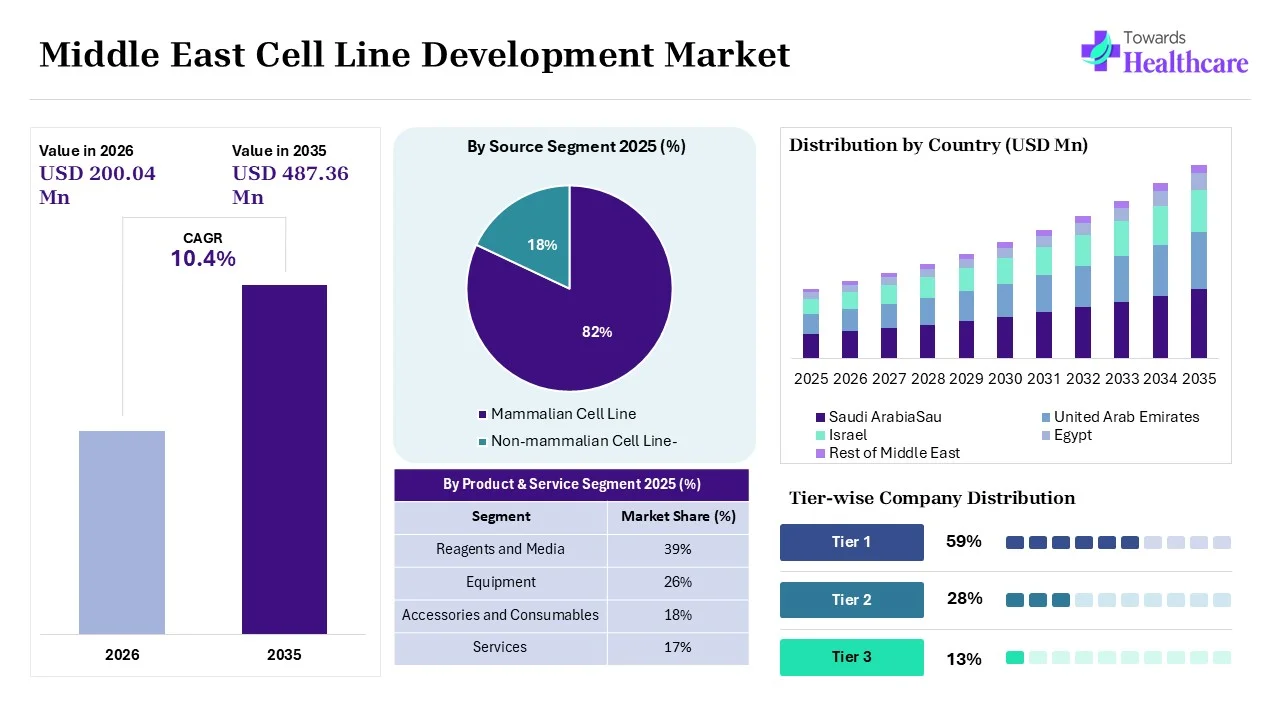
Cell line development is the process of creating stable, high-performance cell lines that consistently produce biologics, vaccines, or other therapeutic proteins for research, development, and commercial manufacturing. The Middle East cell line development market is growing due to increasing investments in local biopharmaceutical manufacturing, rising partnerships between global biotechnology companies and regional organizations, and expanding demand for biologics production. Government initiatives to strengthen life sciences capabilities, improve pharmaceutical self-sufficiency, and establish advanced biotechnology hubs are creating favorable conditions for sustained market growth.
The Middle East cell line development market is expected to expand steadily as governments continue investing in biotechnology infrastructure, research capabilities, and domestic biopharmaceutical manufacturing. Growing support for technology transfer, research collaboration, and skilled workforce development is expected to strengthen regional innovation, improve biologics production capacity, and create long-term opportunities for cell line development across the Middle East.
In December 2025, Saudi Arabia continued implementing its National Biotechnology Strategy, focusing on expanding biomanufacturing, strengthening research infrastructure, and attracting global biotechnology investments.
In October 2025, the UAE Ministry of Health and Prevention (MOHAP) advanced national precision medicine and genomics programs to strengthen biotechnology research, personalized medicine, and local life sciences capabilities.
| Indicator | Numerical Data |
| Growth in biotechnology clinical trials applications in Saudi Arabia | 83% increase |
| Increase in early-stage clinical trials in Saudi Arabia | 39% increase |
| Patient benefiting from biotechnology clinical trial in Saudi Arabia | 2700 patients |
| Reduction in clinical trials approval time under the SFDA reliance pathway | 74% faster |
| Duration of Saudi Arabia’s first national Biotech Accelerator programs | 7 Months |
The rapid growth in biotechnology clinical research and government-backed innovation programs demonstrates the Middle East’s increasing commitment or life science. Rising clinical trial activity, faster regulatory approvals, and dedicated biotechnology accelerator initiatives are strengthening the regional ecosystem for biologics research and manufacturing, thereby supporting long-term demand for cell line development technologies and services.
The reagents and media segment dominated the Middle East cell line development market with a share of 39% in 2025 due to their essential role in cell culture, cell growth, transfection, and clone selection throughout the development process. Rising biologics research, increasing biopharmaceutical manufacturing activities, and continuous demand for high-quality culture media and specialized reagents across research institutions and biotechnology companies further strengthened the segment’s leadership.
The mammalian cell lines segment led the Middle East cell line development market with a share of 82% in 2025 due to its ability to produce complex therapeutic proteins with human-like post-translational modifications, making it the preferred platform for monoclonal antibodies, recombinant proteins, and advanced biologics. Growing investment in biopharmaceutical manufacturing, biosimilar development, and precision medicine initiatives further strengthened the segment’s dominant position in the market.
The recombinant cell lines segment held a dominant share of 42% in 2025 due to their widespread use in producing monoclonal antibodies, recombinant proteins, vaccines, and other biologics with high consistency and yield. Increasing investment sin biopharmaceutical manufacturing, expanding biosimilar development, and growing adoption of recombinant DNA technologies for therapeutic production further reinforced the segment's leading market position.
The bioproduction segment dominated the Middle East cell line development market with a share of 46% in 2025 due to increasing demand for monoclonal antibodies, recombinant proteins, vaccines, and biosimilars. Growing investment in regional biopharmaceutical manufacturing, rising adoption of high-yield cell lines, and expanding biologics production capabilities supported the segment’s leadership. Additionally, government initiatives to strengthen domestic biomanufacturing further contributed to this dominant market position.
The Middle East cell line development market is growing increasing government investments in biotechnology, expanding regional biopharmaceutical manufacturing capabilities, and rising demand for biologics and biosimilars. Favorable regulatory initiatives, strategic public-private collaborations, and the establishment of advanced research and manufacturing facilities are accelerating cell line development activities, while strengthening the region’s position in the global biopharmaceutical value chain.
Leading companies in the market include Cytiva, Thermo Fisher Scientific, Sartorius AG, Merck KGaA, Danaher Corporation, Lonza Group, King Abdullah International Medical Research Center (Saudi Arabia), and M42 (UAE). These organizations are driving market growth through continuous advancements in stable cell line development, cell culture media, gene expression technologies, bioprocessing platforms, and biologics manufacturing solutions. Ongoing investments in biotechnology research, biomanufacturing infrastructure, technology transfer, and regional life sciences partnerships are further strengthening their presence across the Middle East biopharmaceutical ecosystem.
By Product & Service
By Source
By Type of Cell Lines
By Application
By Region
Speak with a healthcare analyst about your research, consulting, or platform needs.