
Find the Right Market Report
Search thousands of industry reports, market insights, and research studies in one place.
Search thousands of industry reports, market insights, and research studies in one place.
The Hospital assisted surgical robot procedures market is projected to expand from USD 13.83 billion in 2026 to USD 55.95 billion by 2035, with a CAGR of 16.8%.


The global hospital assisted surgical robot procedures market size was estimated at USD 11.84 billion in 2025 and is predicted to increase from USD 13.83 billion in 2026 to approximately USD 55.95 billion by 2035, expanding at a CAGR of 16.8% from 2026 to 2035. The market is witnessing strong growth due to the increasing adoption of minimally invasive surgeries, continuous advancements in robotic technologies. and rising investments in modern healthcare infrastructure. Growing demand for greater surgical precision, improved patient outcomes, and expanding applications across multiple surgical specialties is expected to drive sustained market growth through the forecast period.
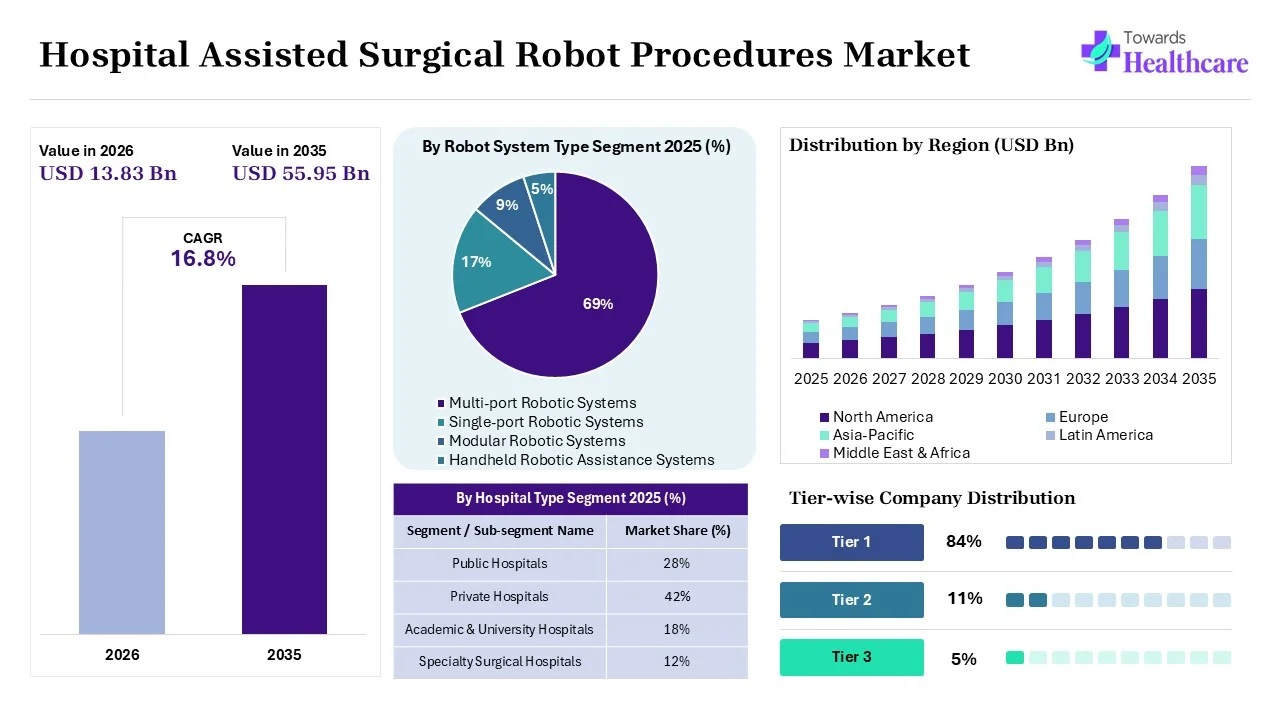
Hospital assisted surgical robot procedures are robot assisted surgical interventions performed in hospitals, where advanced robotic systems help surgeons improve precision, control, and accuracy during minimally invasive and complex surgical procedures. The hospital assisted surgical robot procedure market is growing due to the increasing adoption of minimally invasive procedures, rising demand for greater surgical precision, and improving patient outcomes. Hospitals are investing in advanced robotic systems to reduce complications, shorten recovery times, and enhance operating room efficiency. Continuous technological advancements, expanding surgical applications, and growing healthcare infrastructure are further accelerating market growth.
The hospital assisted surgical robot procedures market is expected to witness significant growth driven by continuous technological advancements, expanding clinical applications, and increasing adoption of invasive surgeries. Greater investments in robotic platforms, improved imaging and navigation systems, and rising demand for precision-based procedures are expected to enhance surgical outcomes and accelerate market expansion across hospitals worldwide.
Government Insights Highlights the Rising Adoption of Hospital Assisted Surgical Robot Procedures
| Parameter (2025) | Data |
| Robot assisted surgeries performed annually in NHS England | 70,000 procedures/year |
| Planned robot-assisted surgeries by 2035 | 500,000 procedures /year |
| Robot-assisted keyhole surgeries targeted by 2035 | 9 out of 10 keyhole surgeries |
| Robotic surgical systems recommended for clinical use | 11 robotic surgical systems |
The table highlights key government-backed statistics demonstrating the rapid adoption of hospital assisted surgical robot procedures. NHS England is significantly expanding the use of robotic surgery to improve surgical precision, reduce recovery times, and enhance patient outcomes. Additionally, the availability of multiple government-recognized robotic surgical systems reflects increasing institutional support for advanced robotic technologies, reinforcing strong growth prospects for the hospital assisted surgical robot procedures market.
High Surgical Volume Position General Surgery at the Forefront
The general surgery segment held a dominant share of 31% in 2025 due to the high volume of procedures performed across hospitals, including colorectal, hernia, and gastrointestinal surgeries. Robotic-assisted systems enhance surgical precision, improve visualization, and support minimally invasive techniques, resulting in better patient outcomes. Increasing hospital adoption of robotic platforms and expanding clinical application further reinforced the segment’s market dominance.
Multi-port Robotic Systems Set the Standards for Advanced Surgical Care
The multi-port robotic systems segment dominated the hospital assisted surgical robot procedures market with a share of 69% in 2025 due to its widespread use in complex surgical procedures across general surgery, urology, gynecology, and cardiothoracic specialties. These systems provide superior instrument dexterity, enhanced 3D visualization, and greater surgical precision. Their proven clinical performance, broad hospital adoption, and extensive surgeon familiarity continued to strengthen their leading market position.
Minimally Invasive Surgery Emerges as the Preferred Surgical Approach
The minimally invasive surgery segment led the hospital assisted surgical robot procedures market with a share of 82% in 2025 due to its ability to deliver greater surgical precision, reduced blood loss, fewer postoperative complications, and faster patient recovery. Hospitals increasingly adopted robotic-assisted minimally invasive procedures to improve clinical outcomes and operational efficiency. Rising preference for less invasive treatments further strengthened the segment’s leading market position.
Soft Tissue Surgery Generates the Largest Revenue in 2025
The soft tissue surgery segment held a dominant share of 36% in 2025 due to the high volume of robotic-assisted procedures performed in general surgery, urology, gynecology, and colorectal surgery. Growing demand for minimally invasive technique, superior surgical precision, improved patient outcomes, and increasing hospital adoption of robotic systems continued to drive the segment’s revenue leadership.
Tertiary Care Hospitals Lead Through Advanced Surgical Capabilities
The tertiary care hospitals segment dominated the hospital assisted surgical robot procedures market with a share of 49% in 2025 due to their advanced surgical infrastructure, availability of specialized surgeons, and high volume of complex procedures. These hospitals are early adopters of robotic-assisted surgical systems, supported by strong investments in advanced medical technologies and comprehensive training programs. Their ability to deliver specialized high-quality surgical care reinforced their leading market position.
North America dominated the hospital assisted surgical robot procedures market with a share of 41% in 2025 due to its advanced healthcare infrastructure, widespread adoption of robotic-assisted surgeries, and strong presence of leading medical device manufacturers. The region also benefits from high healthcare spending, skilled surgeons, favorable reimbursement policies, and continuous investments in surgical innovation, supporting the rapid adoption of robotic technologies across hospitals.
Asia Pacific held 22% share of the market in 2025 and is expected to grow at the fastest CAGR in the market during the forecast period due to expanding healthcare infrastructure, rising investments in robotic surgical technologies, and increasing demand for minimally invasive procedures. A growing patient population, improving access to advanced healthcare, expanding private hospital networks, and supporting government initiatives are further accelerating market growth across the region.
Leading companies in the market include Intuitive Surgical, Medtronic, Johnson & Johnson MedTech, Stryker, Zimmer Biomet, CMR Surgical, Olympus Corporation, and Brainlab. These companies are driving market growth through continuous advancements in robotic surgical platforms, 3D visualization systems, navigation technologies, surgical instruments, and minimally invasive surgery solutions. Ongoing investments in robotic innovation, digital surgery platforms, surgeon training programs, and precision-guided surgical technologies are further strengthening their market position across hospitals and specialty surgical centers.
By Procedure Type
By Robot System Type
By Hospital Type
By Procedure Mode
By Application
By End User
By Region
Speak with a healthcare analyst about your research, consulting, or platform needs.