Find the Right Market Report
Search thousands of industry reports, market insights, and research studies in one place.
Search thousands of industry reports, market insights, and research studies in one place.


Haut.AI Launches AI-Powered Clinical Studies Software for Large-Scale Skin Studies Across Clinic, Hybrid, and At-Home Environments
Haut.AI has launched its AI-driven Clinical Research Software, a validated platform intended to support skincare, cosmetic, ingredient, and dermatology organization conduct large-scale clinical trials in the clinic, hybrid, and remote at-home environments.
Haut.AI, the front-runner in AI-driven skin intelligence, launched its Clinical Studies Software, a dedicated platform intended to supports skincare, beauty, ingredient, and dermatology companies conduct remote and hybrid clinical research in the participant populations of hundreds to thousands.
The platform smears standardized image capture and AI-driven measurement to enumerate 48 validated biomarkers, involving wrinkles, pigmentation, texture, acne, redness, and pore arrival. It allows scientists to gather information remotely or in clinics and generate claims-ready evidence in the cohorts. The platform lowers research setup time by more than 90%, from the typical 8 to 16 weeks to two or three days.
The launch tackles a persistent constraint in clinical skin studies: for decades, clinical skin assessment has trusted on controlled testing environments, expensive instrumentation, limited participant pools, and physical marking by trained experts. Traditional research generally enroll 30 to 35 participants. While these processes remain industry standards, they restrict research scale, increases expenses, restricted geographic reach, and produce results that differ between graders, creating findings complexes to reproduce.
Grader inconsistency is the significant challenges for R&D. The same skin receives various scores from various experts, or from the same expert on different days, adding random noise that obscure a real product effect. An AI-based model applies one standard to each image, in each location, at each timepoint. Its capacities are consistent by construction, so research can run in the multiple sites and areas without sending trained graders to everyone, with results comparable across locations, timepoints, and capture sector.
It creates larger research practical. Where traditional research enrolls lots of participants, the platform is intended to support hundreds or thousands, with at-home images delivering marking quality comparable to technician-captured photographs.
"Clinical research in beauty and skincare has reached an inflection point," said Anastasia Georgievskaya, CEO and Co-Founder of Haut.AI. "The industry has incredible expertise in clinical science, but the tools used to collect and analyze data have remained largely unchanged for years. Our goal is not to replace clinical studies. It's to enhance them by making skin measurable at scale. R&D teams that can measure continuously across larger populations don't just do better science; they make faster decisions."
In traditional effective research, most of the cost sits in work that has to be repeated at each visit and each stage. Haut.AI's Clinical Studies Software mechanizes that work via AI-based measurement and remote self-submission, although ethics approval, compliance, and recruitment remain with the research collaboration. As the remote capture removes per-participant site visit expenses, teams run larger cohorts for comparable total spend. In a typical program, the stage delivers 3x average return on spending, based on an average of six research per year.
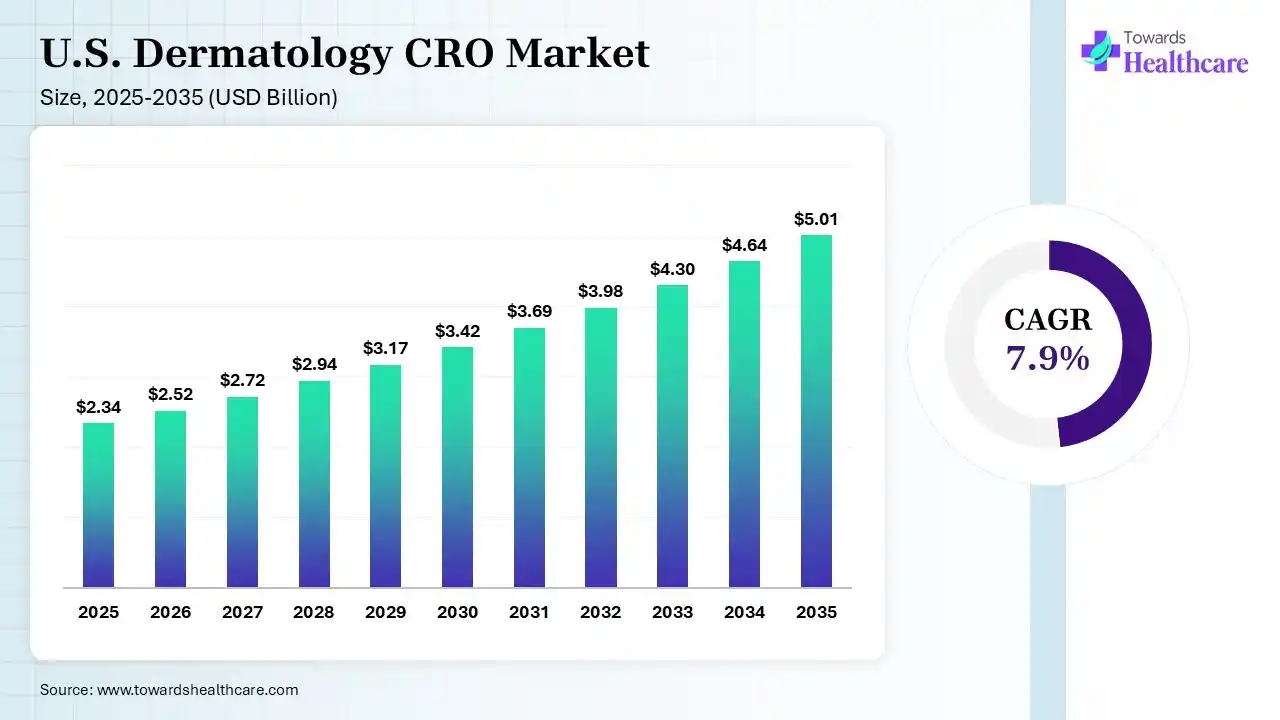
According to Towards Healthcare, the US dermatology CRO market is projected to experience significant growth, with estimates suggesting the market size will increase from USD 2.52 billion in 2026 to approximately USD 5.01 billion by 2035 expanding at a CAGR of 7.9% from 2026 to 2035.Contract research organizations are the support of the clinical research organization, increasing research and development that leads to novel therapies and management. A dermatology CRO is a dedicated clinical research companies which focuses on conducting and managing clinical trials particularly for dermatological conditions and treatments. These organizations offer expertise in skin disorders, cosmetic dermatology, and related therapeutic region, offering services like protocol advancement, patient recruitment, medical care monitoring, regulatory support, and data management tailored to dermatology research. Collaborating with a specialized dermatology contract research organization (CRO) offers targeted expertise, well-developed 3D skin imaging technology, and enhanced patient recruitment for clinical trials tackle skin conditions such as psoriasis, eczema, and acne.
Haut.AI is a SaaS technology organization at the forefront of generative AI-driven skincare personalization and skin intelligence. Founded by scientists and AI innovators, the organization has built proprietary technology which turns skin information in the objective, quantifiable intelligence in all skin tones and body regions. Haut.AI collaborates with leading worldwide beauty and wellness brands involving Neutrogena, Beiersdorf, Ulta Beauty, and Grupo Boticário, allowing them to supply science-backed, hyper-targeted skincare experiences which drive measurable consumer engagement and business impact.
A recent report by Towards Healthcare highlights that the US dermatology CRO market is growing as dermatology CROs bring perticular knowledge of skin disease pathophysiology, valuation scales such as PASI for psoriasis or EASI for eczema, imaging services, and biomarker analysis detailed to dermatological research. Application of high-resolution 3D imaging, digital dermoscopy, and AI-driven skin analysis devices for precise endpoint measurement. Collaborating with a dedicated dermatology contract research organization (CRO) offers biotech, biopharmaceutical, and skincare brands with significant advantages over generalist CROs.
Speak with a healthcare analyst about your research, consulting, or platform needs.