
Find the Right Market Report
Search thousands of industry reports, market insights, and research studies in one place.
Search thousands of industry reports, market insights, and research studies in one place.
The U.S. durable medical equipment market size was estimated at USD 70.7 billion in 2025 and is predicted to increase from USD 74.62 billion in 2026 to approximately USD 121.34 billion by 2035, expanding at a CAGR of 5.55% from 2026 to 2035.
Across the U.S., the healthcare system is facing a vast rise in the aged population, who are highly prone to different chronic diseases, and this raises demand for home-based settings. Moreover, robust companies are actively investing in the development of advanced remote monitoring devices and AI-powered solutions to avoid dependency.
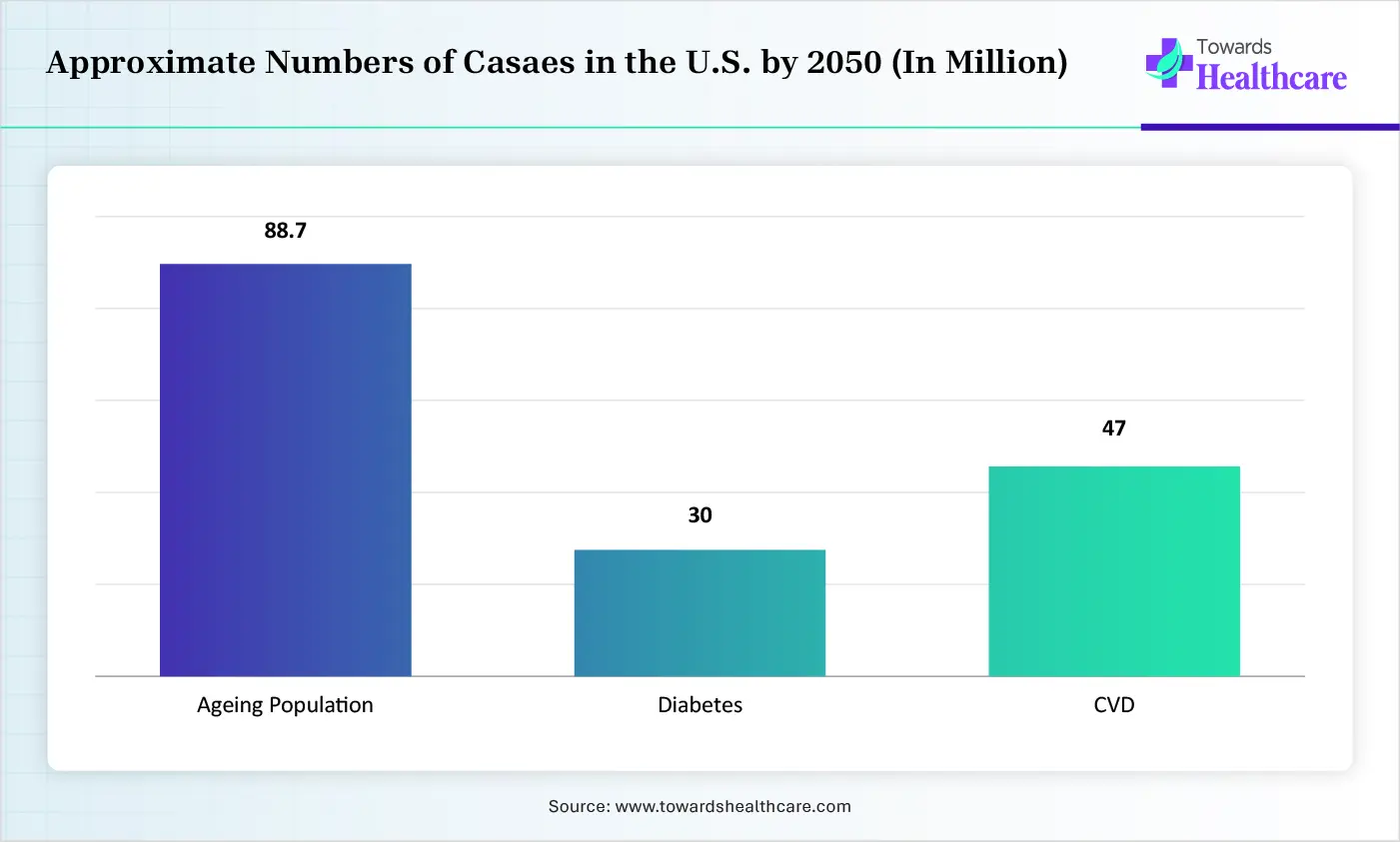
Primarily, the overall U.S. durable medical equipment market is transforming due to the massive rise in the ageing population and gradually increasing chronic issues, like diabetes, heart disease, and respiratory disorders. This further demands long-term care equipment, such as oxygen concentrators & diabetic management devices. Another catalyst assisting the expansion of DME in the U.S. is surgical hospitals expenditures & patient preference for home settings.
Eventually, a huge expansion in chronic diseases is fostering the novelty, breakthroughs in DME, which mainly pushes wearable health monitors & sensors. These kinds of devices are leveraging AI algorithms to track critical signs, like heart rate & oxygen saturation, which further provide real-time analytics for remote patient management. Alongside, the broader application of intelligent CPAP machines & mobility devices is utilizing machine learning to bolster treatment delivery, whereas AI simplifies the reimbursement process for these devices.
Spurring Intelligent & Portable Mobility Aids
This era is actively fostering novel personal mobility devices, like wheelchairs, scooters, and walkers, which are more lightweight, foldable, & user-friendly to raise independence for the elderly population.
Moving Towards ‘As-a-Service’ Models
Many healthcare providers are widely leveraging rental-based and equipment-as-a-service models, which enable strong asset utilization tracking & minimal capital spending.
Emphasizing Cybersecurity & regulatory Compliance
Researchers are focusing on strong cybersecurity measures to secure patient data in connected equipment, in accordance with the FDA Cybersecurity-in-Medical-Devices-Quality-System-Considerations-and-Content-of-Premarket-Submissions.
Internal factors include product quality, technological capabilities, manufacturing efficiency, pricing, distribution networks, brand reputation, and companies’ ability to develop user-friendly equipment. External factors include aging demographics, chronic disease prevalence, healthcare spending, home healthcare adoption, reimbursement policies, regulatory requirements, and changing patient preferences. Growing demand for remote monitoring and connected devices creates opportunities for manufacturers to introduce innovative equipment.
However, high equipment costs, reimbursement complexities, supply-chain disruption, and competition can restrict adoption. Technological progress in sensors, connectivity, and smart monitoring supports product differentiation, while changing healthcare delivery models encourage home-based equipment usage. Consumer expectations for convenience, portability, safety, and personalized care further influence purchasing decisions and product development.
U.S. durable medical equipment refers to reusable medical devices designed for extended use to support patients with medical conditions, disabilities, mobility limitations, or ongoing healthcare needs. The market is growing as healthcare delivery increasingly shifts towards home-based and patient-centered care. Current trends include connected equipment, remote monitoring devices, portable mobility solutions, and smart respiratory equipment. Future opportunities are emerging through personalized home care, remote patient management, rehabilitation technologies, and digitally connected medical devices.
Technological advancements in sensors, artificial intelligence, wireless connectivity, remote monitoring, and data integration are improving equipment functionality and patient support. Key drivers include the aging population, increasing prevalence of chronic conditions, rising preference for home healthcare, expanding healthcare accessibility, demand for improved patient independence, and technological innovation. Greater emphasis on reducing hospital stays and supporting long-term disease management is also encouraging healthcare providers and patients to adopt reliable, technologically advanced durable medical equipment.
| Table | Scope |
| Market Size in 2026 | USD 74.62 Billion |
| Projected Market Size in 2035 | USD 121.34 Billion |
| CAGR (2026 - 2035) | 5.55% |
| Historical Data | 2020 - 2023 |
| Base Year | 2025 |
| Forecast Period | 2026 - 2035 |
| Measurable Values | USD Millions/Units/Volume |
| Market Segmentation | By Product , By End Use |
| Top Key Players | Invacare Corporation, Sunrise Medical, Arjo, Medline Industries, Inc., GE HealthCare, GF Healthcare Products, Inc., Carex Health Brands, Inc., Cardinal Health, Drive DeVilbiss Healthcare, NOVA Medical Products |
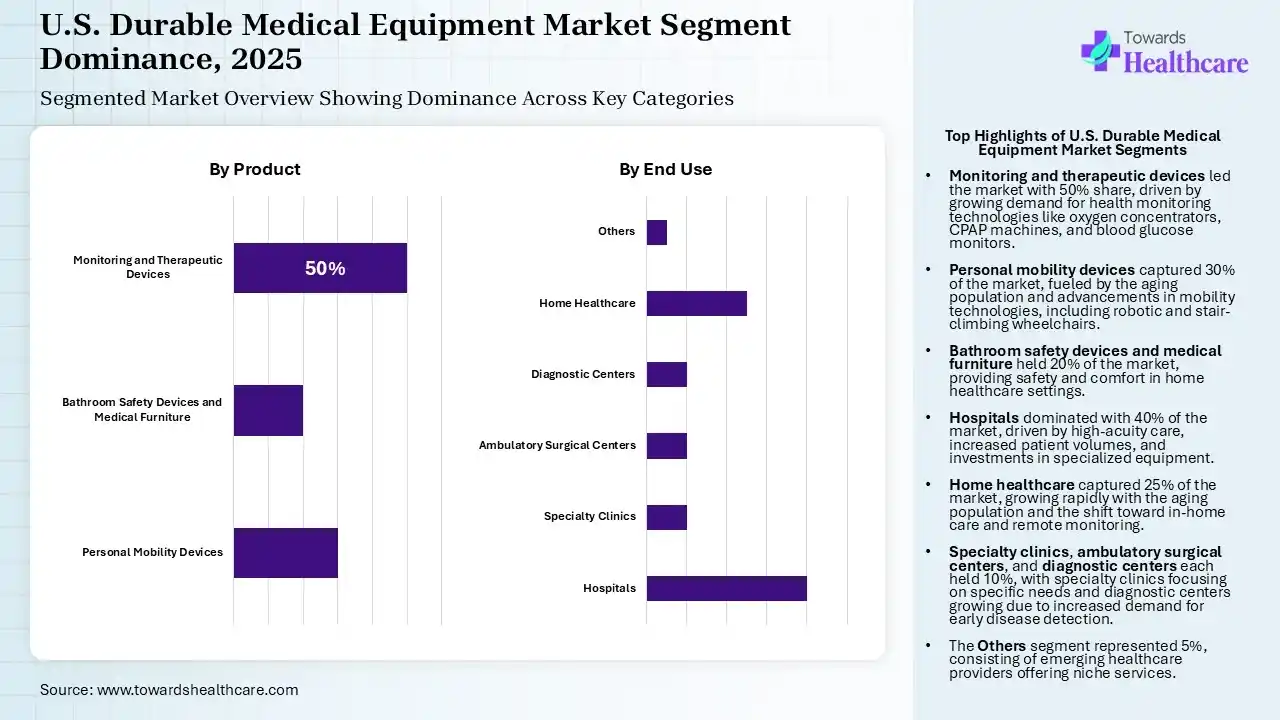
Which Product Led the U.S. Durable Medical Equipment Market in 2025?
| Segment | Share 2025 (%) |
| Personal Mobility Devices | 30% |
| Bathroom Safety Devices and Medical Furniture | 20% |
| Monitoring and Therapeutic Devices | 50% |
Explanation
In 2025, the monitoring and therapeutic devices segment registered dominance in the market by 30%. This mainly covers portable oxygen concentrators, CPAP machines, and blood glucose monitors, to meet the increasing need for these devices in the growing number of various chronic concerns, especially among geriatric populations. Emerging trends are transforming extensive ECG patches & advanced wrist-mounted devices to monitor heart rate variability, blood pressure, & oxygen saturation, & this conveys data directly to providers to lower re-hospitalization.
Personal Mobility Devices
In the coming era, the personal mobility devices segment is predicted to expand rapidly. Eventual expansion is fueled by the accelerating technological advances, supportive reimbursement policies, and raised demand for home care measures. Certain efforts are exploring innovative wheelchair models, like iBOT duo, Robooter X40, with their gyroscopic technology for balancing, terrain versatility, & autonomous barrier omission. Also, these devices are pushing robotic wheelchairs & using stair-climbing capabilities to boost accessibility.
How did the Hospitals Segment Dominate the Market in 2025?
| Segment | Share 2025 (%) |
| Hospitals | 40% |
| Specialty Clinics | 10% |
| Ambulatory Surgical Centers | 10% |
| Diagnostic Centers | 10% |
| Home Healthcare | 25% |
| Others | 5% |
Explanation
The hospitals segment held the biggest share of the U.S. durable medical equipment market by 40% in 2025. Across the U.S. hospitals, surging patient volumes and the demand for instant, high-quality care after surgeries are propelling major investments in specialized equipment, including ventilators & patient positioning devices. These hospitals are combining procurement & maintenance of these devices, which significantly reduces expenditures.
Home Healthcare
The home healthcare segment is anticipated to expand fastest. With a gradually rising geriatric population, and to eliminate huge hospital costs & stays, patients are demanding home healthcare devices. Ongoing advances in smart DME have been stepping towards digital connectivity for remote monitoring, which enables healthcare providers to track patient health & maintain equipment remotely.
The U.S. durable medical equipment (DME) market is experiencing robust growth, driven by an aging population, rising chronic diseases, and a shift toward home-based care. The market is increasingly adopting smart, connected devices and lightweight, user-friendly equipment. Regional growth is uneven, with the South dominating, while the West shows high demand for advanced technology.
Across all regions, the shift towards home healthcare is accelerating growth, expected to be the fastest-growing end-user segment. Medicare and Medicaid expansion for innovative, AI-enabled mobility aids and telehealth-compatible devices is also crucial to this growth. While monitoring and therapeutic devices currently lead in revenue, personal mobility devices (wheelchairs, scooters) and bathroom safety equipment are experiencing rapid demand growth due to fall prevention initiatives. The market is also moving toward rental and subscription models, allowing providers to better manage costs and equipment utilization.
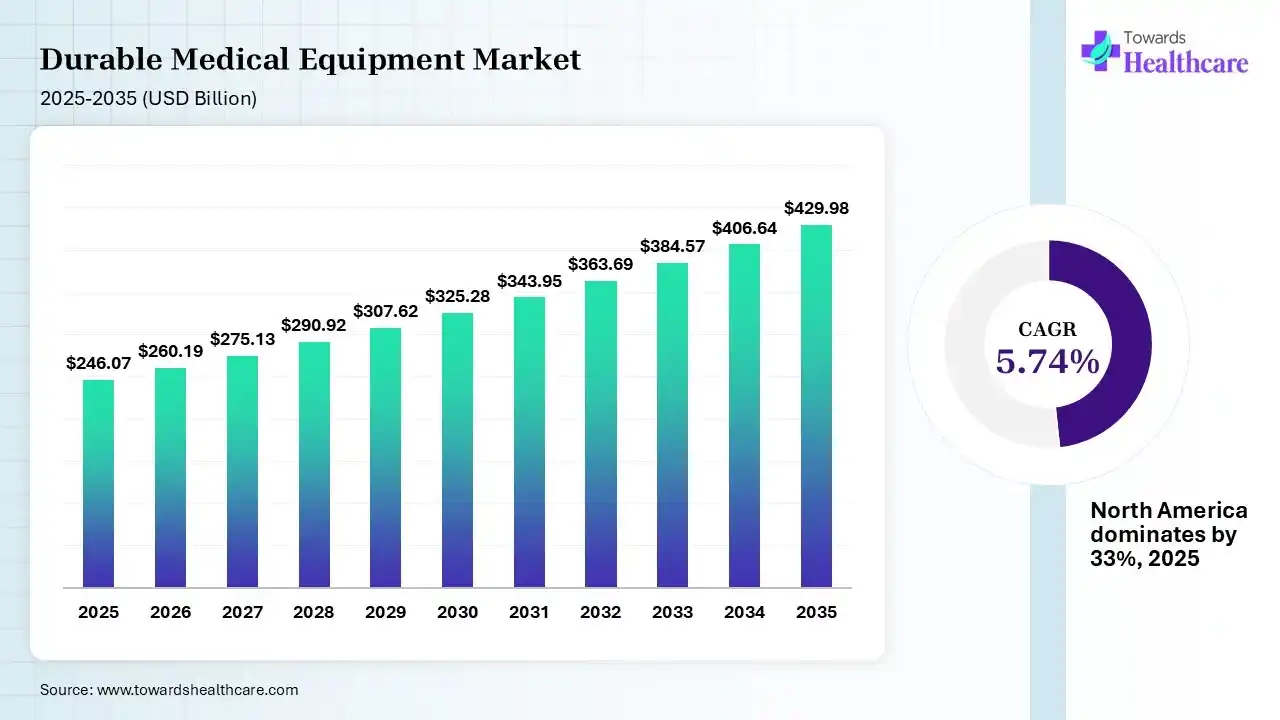
The global durable medical equipment market size was estimated at USD 246.07 billion in 2025 and is predicted to increase from USD 260.19 billion in 2026 to approximately USD 429.98 billion by 2035, expanding at a CAGR of 5.74% from 2026 to 2035.
R&D
Manufacturing Process
Distribution to Hospitals & Clinics
| Company | Description |
| Invacare Corporation | This especially offers power and manual wheelchairs, seating and positioning products, respiratory equipment & home care beds. |
| Sunrise Medical | A firm specializes in manual and power wheelchairs, scooters, & seating/positioning systems |
| Arjo | Its offerings include medical beds, specialized support surfaces, patient lifts (ceiling/floor), hygiene systems, & VTE prevention devices. |
| Medline Industries, Inc. | This facilitates mobility aids (wheelchairs, walkers), bath safety items, hospital beds, & respiratory equipment. |
| GE HealthCare | A company provides various CT scanners, MRI systems, ultrasound machines, ECG machines, vital sign monitors, etc. |
| GF Healthcare Products, Inc. | This has explored Everest & Jennings wheelchairs, Lumex patient aids/seating, Basic American beds, Hausted surgical stretchers, & John Bunn respiratory products. |
| Carex Health Brands, Inc. | This primarily offers mobility aids, bath safety products, pain management tools, & personal care aids designed for home, rehabilitation, & assisted living settings. |
| Cardinal Health | A leader focuses on mobility aids, i.e., walkers, wheelchairs, bath safety products, respiratory equipment, and home-based medical equipment. |
| Drive DeVilbiss Healthcare | Their offerings cover wheelchairs, rollators, walkers, beds, bath safety products, & sleep therapy devices. |
| NOVA Medical Products | A firm provides diverse transport chairs, walkers/rollators, canes, and bath safety items. |
Strengths
Weaknesses
Opportunities
Threats
By Product
By End Use
Speak with a healthcare analyst about your research, consulting, or platform needs.




 sales@towardshealthcare.com