USD 13.07 Million
Revenue, 2025
USD 32.21 Million
Forecast, 2035
UAE Protein Chip Market Trends for 2026
The UAE protein chip market is anticipated to grow from USD 13.07 million in 2025 to USD 32.21 million by 2035, with a compound annual growth rate (CAGR) of 9.44% during the forecast period from 2025 to 2035.
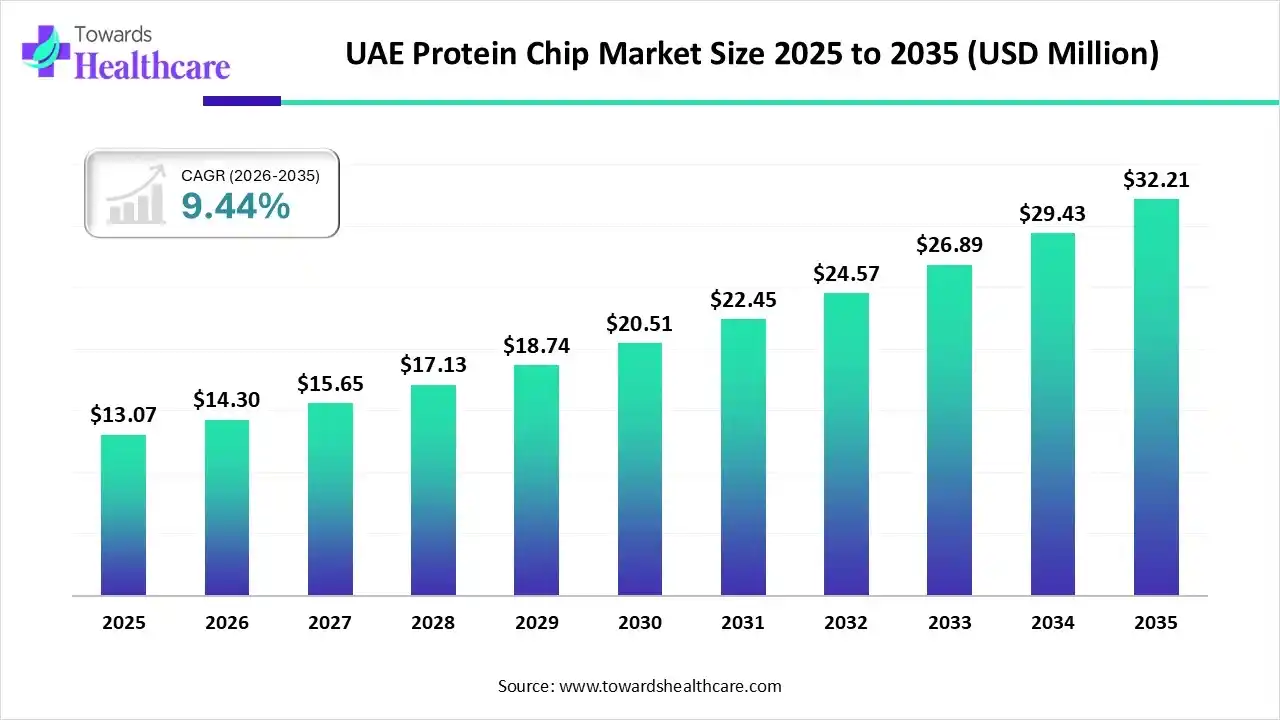
The UAE protein chip market is steadily expanding, fueled by strong government efforts to promote biotechnology and precision medicine. Growing healthcare infrastructure, increased investment in clinical research, and collaborations with global biotech firms are encouraging the use of advanced proteomic tools for diagnostics, biomarker discovery, and personalized treatment.
The Middle East and Africa offer significant growth opportunities in the market due to increasing healthcare modernization, rising investment in biotechnology research, and greater awareness of advanced diagnostic technologies. Expanding collaborations with global biotech companies and the development of clinical research centers are driving regional market growth.
Key Takeaways
- The protein chip market is forecast to grow from USD 2.36 billion in 2025 to USD 4.98 billion by 2035, with a CAGR of 7.78%.
- UAE is a major contributor to the North America protein chip market by 1%.
- Planar Protein Microarrays dominate the market with a 38% share, followed by Label-Free & Biosensor Arrays at 20%.
- Biomarker Discovery & Validation holds the largest application share at 30%, with Clinical Diagnostics & Companion Diagnostics at 24%.
- Pharmaceutical & Biotech Companies lead the end-user market with 34%, while Academic & Research Institutes contribute 14%.
- Label-based Fluorescence / Chemiluminescence Assays make up 45% of the detection chemistry market, with Label-free detection growing to 20%.
- Protein Chip Kits & Reagents account for 36% of the product market, followed by Array Substrates & Slides at 18%.
Growing Demand Drives UAE Protein Chip Market
The protein chip market in the UAE is undergoing consistent growth, which is facilitated by the rise in investments towards precision medicine, clinical diagnostics, and biomedical research. Protein chips are sophisticated microarray systems that allow for the simultaneous identification, detection, and analysis of multiple protein substances from one sample, and thus aid in the process of diagnosis and drug development. The market growth is further supported by the enhanced healthcare systems in the country, along with the increasing use of personalized medicine and greater emphasis on genomics and proteomics. Also, the presence of several government programs advocating for life sciences development and the research institutions- health care providers collaborations give a boost to the market growth. In addition, there is an increase in chronic disease cases and the need for upgraded diagnostics which makes the protein chip market favorable.
Powering Precision Healthcare: UAE Protein Chip Market Accelerates Next-Generation Diagnostics
The UAE protein chip market focuses on protein microarray technologies that enable rapid, high-throughput analysis of proteins, antibodies, biomarkers, and molecular interactions for clinical diagnostics, drug discovery, proteomics research, and precision medicine. The market is expanding as the UAE strengthens its biotechnology ecosystems, invests in genomics medicine, and advances personalized healthcare. Increased prevalence of chronic diseases and growing collaborations between healthcare providers, research institutes, and biotechnology companies are driving adoption. Technological advancements, including AI-enabled proteomics analytics, multiplex protein microarrays, automation, and cloud-based data integration, are improving diagnostic accuracy and research efficiency. Future opportunities lie in company diagnostics, oncology biomarker discovery, infectious disease surveillance, and precision therapeutics, supported by continued investments in life sciences research, digital health infrastructure, and advanced laboratory capabilities.
Artificial Intelligence Changing the Landscape of Protein Chips in UAE
Artificial intelligence is disrupting the protein chip industry in UAE through enhanced functionality in conducting protein analysis. The utilization of AI technology allows for better interpretation of complicated proteomic data, identifying disease biomarkers, and earlier development of personalized medicines. These combines with application of machine learning ensure accurate connections with other aspects in the industry leading to less man-hour spent on analyses and thus increasing accessibility of advanced testing.
Future Trends In Protein Chip Market Of UAE
- Increasing Usage of Organ-on-Chip Technologies: UAE is implementing the usage of protein chip and organ-on-chip technologies extensively for drug discovery and toxicity testing. Such advanced technologies minimize the need for animal testing, enhances the accuracy of research and speeds up the process of development of pharmaceuticals by using the models based on real human tissues.
- Growing Adoption of Precision Medicine Initiatives: The growing investments in personalized health care are increasing the demand for protein chip technologies. The hospitals and different research institutions are likely to implement protein profiling in their efforts of early disease diagnosis, personalized treatments and targeting therapies in areas like oncology and management of chronic diseases.
- Increased Collaboration for Biopharmaceutical Research: The collaborations between hospitals, universities and private companies will enhance protein chip development. The collaborative research is expected to help in the faster discovery of biomarkers, development of therapies and commercialization of advanced diagnostic systems in UAE.
Protein Chip Market Quick Stats and Facts
| Key Elements |
Scope |
| Market revenue in 2026 |
USD 14.30 Million |
| Market revenue in 2035 |
USD 32.21 Million |
| Growth Rate (2025 - 2035) |
9.44% |
| Historical Data |
2020 - 2023 |
| Base Year |
2025 |
| Forecast Period |
2026 - 2035 |
| measurable Values |
USD Millions/Units/Volume |
| Market Segmentation |
By Platform Type, By Application, By End User, By Detection Chemistry / Assay Type, By Product / Offering |
| Key Players |
PerkinElmer Inc., BioRad Laboratories, Illumina, Inc., RayBiotech Life, Inc., Arrayit Corporation, Danaher Corporation |
Segments Covered
By Platform Type
| Segments |
Shares 2025 (%) |
| Planar Protein Microarrays |
38% |
| Bead-Based / Suspension Arrays |
18% |
| Reverse-Phase Protein Arrays (RPPA) |
12% |
| Label-Free & Biosensor Arrays |
20% |
| Peptide Arrays & Epitope Mapping Chips |
6% |
| Other Custom / Specialty Arrays |
6% |
- Planar Protein Microarrays (38%): These arrays, made from glass slides and printed arrays, form the foundation of the protein chip market due to their established use in research.
- Bead-Based / Suspension Arrays (18%): Bead-based arrays, like those from Luminex, are used for multiplexing assays and have gained traction in various protein profiling applications.
- Reverse-Phase Protein Arrays (RPPA) (12%): RPPA is a specialized array used for protein expression analysis and remains essential in cancer research and biomarker discovery.
- Label-Free & Biosensor Arrays (20%): This category, including SPR and nanoplasmonic technology, is rapidly growing because it allows real-time protein analysis without the need for labeling.
- Peptide Arrays & Epitope Mapping Chips (6%): These arrays are specialized for studying protein-peptide interactions and antibody binding, playing a key role in vaccine and immunology research.
- Other Custom / Specialty Arrays (6%): This segment includes specialized arrays, such as cell-based or glycan-protein arrays, tailored for specific research needs.
By Application
| Segments |
Shares 2025 (%) |
| Biomarker Discovery & Validation |
30% |
| Drug Target Identification & Pharmacodynamics |
18% |
| Clinical Diagnostics & Companion Diagnostics |
24% |
| Immune Profiling & Vaccine Research |
10% |
| Protein–Protein Interaction & Pathway Analysis |
7% |
| Quality Control / Bioprocess Monitoring |
6% |
| Others (agriand environmental proteomics) |
5% |
- Biomarker Discovery & Validation (30%): This application is the largest in the market, as identifying new biomarkers is critical for disease diagnosis and drug development.
- Drug Target Identification & Pharmacodynamics (18%): This segment focuses on understanding how drugs interact with proteins, a crucial step in the drug development process.
- Clinical Diagnostics & Companion Diagnostics (24%): This rapidly growing segment addresses the need for diagnostic tools used alongside therapies to personalize treatments.
- Immune Profiling & Vaccine Research (10%): With the increasing focus on immunology, this segment is growing due to the importance of profiling immune responses for vaccine development.
- Protein–Protein Interaction & Pathway Analysis (7%): This segment studies protein interactions, which are vital for understanding cellular functions and disease mechanisms.
- Quality Control / Bioprocess Monitoring (6%): Used in manufacturing, this segment ensures the quality of biotherapeutic products through protein analysis.
- Others (5%): This category includes niche applications in areas such as agricultural and environmental proteomics.
By End User
| Segments |
Shares 2025 (%) |
| Pharmaceutical & Biotech Companies |
34% |
| Academic & Research Institutes |
14% |
| Clinical & Diagnostic Laboratories |
18% |
| Contract Research Organizations (CROs) |
12% |
| Industrial / Bioprocess QC Users |
10% |
| Other (agriculture, food safety labs) |
12% |
- Pharmaceutical & Biotech Companies (34%): These companies are the largest consumers of protein chip technology for drug discovery and development.
- Academic & Research Institutes (14%): Researchers in academic settings use protein chips for various studies, including basic biological research.
- Clinical & Diagnostic Laboratories (18%): Clinical labs utilize protein chips for diagnostic purposes and personalized medicine approaches.
- Contract Research Organizations (CROs) (12%): CROs offer protein chip services to pharmaceutical companies and academic researchers, contributing significantly to the market.
- Industrial / Bioprocess QC Users (10%): This sector uses protein chips for monitoring quality in the production of biologic drugs and vaccines.
- Other (12%): This category includes agricultural and food safety labs that apply protein chip technologies for various analyses.
By Detection Chemistry / Assay Type
| Segments |
Shares 2025 (%) |
| Label-based Fluorescence / Chemiluminescence Assays |
45% |
| Enzyme-Linked / Colorimetric Assays |
15% |
| Label-free (SPR, interferometry, photonic) |
20% |
| Antibody/Antigen Capture Sandwich Assays |
10% |
| Affinity / Binding Kinetics Assays |
5% |
| Other (lectin-binding, glycoprotein-specific assays) |
5% |
- Label-based Fluorescence / Chemiluminescence Assays (45%): These assays are the most widely used due to their high sensitivity and well-established protocols.
- Enzyme-Linked / Colorimetric Assays (15%): These assays are commonly used in protein detection, especially in clinical and diagnostic applications.
- Label-free (SPR, interferometry, photonic) Detection (20%): This rapidly growing segment allows for real-time, label-free detection of protein interactions, a critical feature for many applications.
- Antibody/Antigen Capture Sandwich Assays (10%): These assays are widely used for detecting specific antigens or antibodies, especially in diagnostic tests.
- Affinity / Binding Kinetics Assays (5%): These assays measure the strength of protein interactions, which is vital for drug development and research.
- Other (5%): Includes various specialized assays for specific applications like glycoprotein or lectin-binding.
By Product / Offering
| Segments |
Shares 2025 (%) |
| Protein Chip Kits & Reagents |
36% |
| Array Substrates & Slides |
18% |
| Detection Instruments & Scanners |
15% |
| Consumables (antibodies, buffers, blocking reagents) |
12% |
| Software & Data Analysis Tools |
12% |
| Contract Services / Assay Development |
7% |
- Protein Chip Kits & Reagents (36%): These kits and reagents are essential for researchers to perform protein analysis using protein chip technology.
- Array Substrates & Slides (18%): These are the physical materials that protein arrays are built on, representing a significant portion of the product market.
- Detection Instruments & Scanners (15%): These instruments are crucial for reading and analyzing protein chips, thus holding a vital share of the market.
- Consumables (antibodies, buffers, blocking reagents) (12%): These essential consumables are used in conjunction with protein chips for optimal performance in experiments.
- Software & Data Analysis Tools (12%): As protein chip technologies generate vast amounts of data, software tools for analysis are growing in demand.
- Contract Services / Assay Development (7%): This segment offers specialized services for assay development, which is critical for customers who need customized solutions.
Precision Medicine Powers UAE’s Leadership in the Protein Chip Market
The UAE protein chip market is leading due to the country’s strong investments in precision medicine, biotechnology, and advanced healthcare infrastructure. Government initiatives promoting genomics research, increasing adoption of AI-enabled diagnostics, and the expansion of world-class research centers are accelerating the use of protein chip technologies. Growing collaboration between hospitals, academic institutions, and biotechnology companies, along with rising demand early disease detection, oncology biomarker research, and personalized medicines, further strengthens market growth. Additionally, the UAE’s strategies focus on becoming a regional life sciences and healthcare innovation hub continue to attract investments and support the adoption of advanced proteomics solutions
Top Companies in the UAE Protein Chip Market
- PerkinElmer Inc.
- BioRad Laboratories
- Illumina, Inc.
- RayBiotech Life, Inc.
- Arrayit Corporation
- Danaher Corporation
Key Announcements By Industry Players:
- In February 2026, At the World Health Expo in Dubai, the UAE unveiled Organ-on-Chip technology to advance drug testing and biomedical research. "This technology represents a major step toward faster, more accurate, and ethical drug development," officials highlighted during the launch, emphasizing its role in strengthening precision medicine and life sciences innovation.
- In January 2026, The UAE announced a major strategic push into the alternative protein sector to enhance food security and sustainable innovation. Authorities stated that the initiative aims to "position the UAE as a global leader in alternative proteins and future food systems," supporting investment and research.
- In February 2026, During the World Governments Summit 2026, the UAE introduced the world's largest AI chip featuring 4 trillion transistors. Officials said the breakthrough "marks a significant milestone in advancing AI computing capabilities and reinforcing the UAE's leadership in artificial intelligence innovation."
Segments Covered in the Report
By Platform Type
- Planar Protein Microarrays (glass slides, printed arrays)
- Bead-Based / Suspension Arrays (Luminex-style, flow-based)
- Reverse-Phase Protein Arrays (RPPA)
- Label-Free & Biosensor Arrays (SPR, photonic crystal, nanoplasmonic)
- Peptide Arrays & Epitope Mapping Chips
- Other Custom / Specialty Arrays (cell-based arrays, glycan-protein arrays)
By Application
- Biomarker Discovery & Validation
- Drug Target Identification & Pharmacodynamics
- Clinical Diagnostics & Companion Diagnostics
- Immune Profiling & Vaccine Research
- Protein–Protein Interaction & Pathway Analysis
- Quality Control / Bioprocess Monitoring (biomanufacturing)
- Others (agri- and environmental proteomics)
By End User
- Pharmaceutical & Biotech Companies
- Academic & Research Institutes
- Clinical & Diagnostic Laboratories
- Contract Research Organizations (CROs)
- Industrial / Bioprocess QC Users
- Other (agriculture, food safety labs)
By Detection Chemistry / Assay Type
- Label-based Fluorescence / Chemiluminescence Assays
- Enzyme-Linked / Colorimetric Assays
- Label-free (SPR, interferometry, photonic) Detection
- Antibody/Antigen Capture Sandwich Assays
- Affinity / Binding Kinetics Assays
- Other (lectin-binding, glycoprotein-specific assays)
By Product / Offering
- Protein Chip Kits & Reagents
- Array Substrates & Slides
- Detection Instruments & Scanners
- Consumables (antibodies, buffers, blocking reagents)
- Software & Data Analysis Tools
- Contract Services / Assay Development





 sales@towardshealthcare.com