
Find the Right Market Report
Search thousands of industry reports, market insights, and research studies in one place.
Search thousands of industry reports, market insights, and research studies in one place.
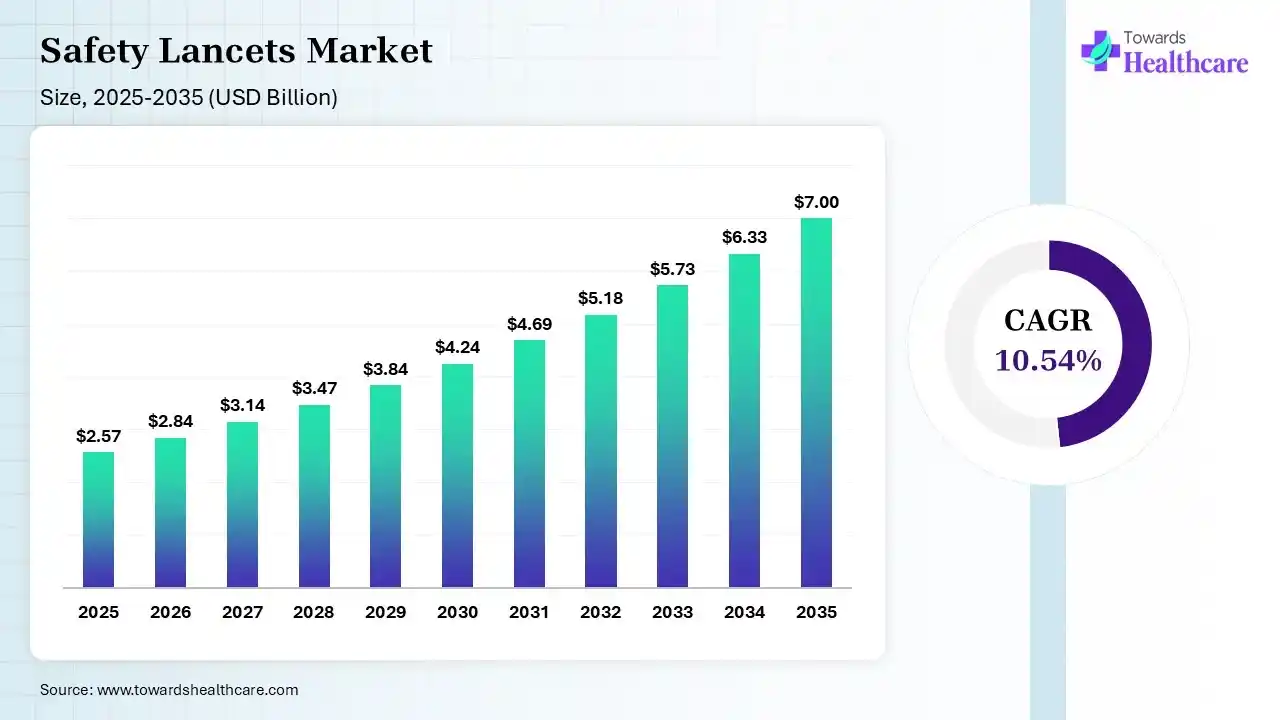
The safety lancets market size stood at US$ 2.57 billion in 2025, grew to US$ 2.84 billion in 2026, and is forecast to reach US$ 7.00 billion by 2035, expanding at a CAGR of 10.54% from 2026 to 2035.
Lancets are small, sharp needles used to puncture the skin to withdraw a minuscule quantity of blood. However, standard lancets carry the risk of needlestick injuries. Safety lancets are a safer alternative to standard lancets as they contain retractable needles, thereby preventing accidental pricks and reducing the risk of infection. Safety lancets are more specific and personalized to every patient type, as they can puncture and penetrate to a predetermined depth during sample collection. These lancets are commonly used to withdraw blood during blood glucose monitoring. They are also used in various tests such as lipid profiles, HbA1C, and blood typing.
The rising prevalence of chronic disorders like diabetes and cholesterol increases the demand for safety needles. The rising needlestick injuries from standard lancets promote the use of safety lancets. Additionally, technological advancements and the latest innovations in safety lancets boost market growth.
Safety lancets are single-use medical devices designed to obtain small blood samples through a controlled skin puncture while reducing the risk of accidental needlestick injuries. The track and trace solution market is growing as manufacturers and healthcare providers seek stronger product identification, supply-chain visibility, inventory control, and protection against counterfeit devices. Key trends include barcode serialization, QR-based identification, RFID tagging, connected inventory systems, and digital product authentication. Technological advancements in IoT enable real-time tracking, automated verification, and improved supply-chain monitoring. Major drivers include increasing blood glucose testing, growing adoption of home-based diagnostics, infection-control requirements, rising safety awareness, and the need for efficient product recalls. Future opportunities include smart packaging, automated inventory tracking, AI-enabled demand forecasting, digital authentication, and integrated platforms connecting manufacturers, distributors, diagnostic centers, hospitals, pharmacies, and home healthcare users.
The development of blood self-sampling devices or lancing devices increases the demand and use of safety lancets. These devices automatically collect blood samples from the skin, offering a standardized and safe approach to obtaining blood samples. This benefits children, the geriatric population, and adults having a fear of piercing their skin. Hence, the advent of self-sampling devices increases patient adherence. These devices enable interoperability and interface with the current total lab automation. Additionally, they are affordable, sustainable, and of high quality. The devices either collect blood from the upper arm or prick the finger. Blood sampling can maintain laboratory testing for patients who live far away from the hospital. The increasing investments in microfluidics and demand for safe, latest innovations and painless withdrawal of blood potentiate the market growth.
Patients from numerous developing countries are unaware of the safety lancets for withdrawing capillary blood. Most of the people use conventional lancets as they are a cheaper alternative and easily available. Safety lancets are also not preferred due to pain, fear and anxiety. This hampers the market growth.
North America held the largest share of the safety lancets market in 2025. The rising prevalence of diabetes and other disorders, advanced healthcare infrastructure, increasing investments, and technological advancements drive the market. In 2022, around 38.4 million people in the US and around 5.7 million people in Canada were suffering from both type 1 and 2 diabetes. According to the Centers for Disease Control and Prevention, more than half of the US citizens are suffering from cholesterol. The Occupational Safety and Health Administration promotes the use of safety lancets among healthcare workers who perform finger-prick blood sampling in the workplace to prevent needlestick injuries. The Canadian Government governs the use of glucometers, test strips, and lancets for regular monitoring of blood glucose levels with an aim to prevent serious diabetes complications and long-term hospitalizations. The market is also driven by increasing awareness, and the presence of key players augment market growth.
U.S. Safety Lancets Market Driven by Advanced Healthcare Adoption
The U.S. market is expanding through widespread diabetes screening, high adoption of advanced point-of-care diagnostics, strong demand for automated safety features, and established medical-device distribution networks. Growing utilization of self-testing technologies and increasing preference for ergonomically designed lancets are creating additional opportunities for manufacturers across hospitals, pharmacies, laboratories, and homecare environments.
Canada’s Safety Lancets Market Benefits from Accessible Healthcare
Canada is notably growing due to increasing preventive health screening, expansion of community-based healthcare services, and rising demand for convenient diagnostic equipment in remote and underserved areas. Growing use of portable testing devices and emphasis on reducing occupational exposure among healthcare workers are encouraging healthcare facilities to adopt safer blood-collection solutions.
Asia-Pacific is projected to host the fastest-growing safety lancets market in the coming years. The rising geriatric population, increasing prevalence of diabetes and other chronic illnesses, increasing investments, and demand for point-of-care diagnostics drive the market. The rising prevalence of chronic disorders potentiates regular testing for these disorders, thereby increasing the demand for safety lancets. China accounts for more than half of the familial hypercholesterolemia cases in the world. In the Asia-Pacific region, familial hypercholesterolemia accounts for almost 15 million cases. Several organizations conduct training sessions to increase awareness of the use of safety lancets in the region.
India’s Safety Lancets Market Gains from Expanding Diagnostics
India is significantly growing due to rapid expansion of diagnostic centers, increasing affordability of blood-testing devices, and growing availability of medical products beyond major cities. Rising consumer awareness of personal health monitoring and the development of organized retail and pharmacy networks are improving access to safety lancets and supporting their broader adoption.
China’s Safety Lancets Market Strengthened by Domestic Manufacturing
China is notably expanding through strong domestic medical-device production, increasing modernization of healthcare facilities, and wider deployment of diagnostic services in developing regions. Improvements in local manufacturing capabilities are supporting product availability and cost competitiveness, while growing investment in community healthcare and preventive diagnostics is creating additional demand for efficient blood-sampling devices.
Europe is expected to grow significantly in the safety lancets market during the forecast period. The increasing diseases is increasing the use as well as demand for the safety lancets in Europe. At the same time, due to their easy and safe use, their adoption in homecare settings is also increasing.
The growing incidence of diseases is increasing the use of safety lancets in the healthcare sector. Furthermore, due to its advantages of reducing the risk of infections, it also contributes to the same. Thus, all these factors promote the market growth.
The industries in Germany are focusing on the development of safety lancets due to their increasing use. At the same time, its use in the homecare setting is also rising as they are easy to use. This, in turn, is also supported by the government.
UK Safety Lancets Market Supported by Community Healthcare
The UK market is significantly growing through increasing community-based diabetes services, broader availability of self-monitoring programs, and demand for user-friendly diagnostic devices. Growing emphasis on reducing healthcare-associated risks and improving patient convenience is encouraging the adoption of single-use safety lancets across primary care, pharmacies, specialist clinics, and home-based testing environments.
By type, the pressure-activated safety lancet segment held the largest share in the safety lancets market in 2025. A pressure-activated safety lancet is a device that withdraws blood by placing it on the finger and applying very little pressure, enabling the needle to prick the skin and retract it. It does not contain a button to aid the needle to come out. It is widely preferred due to its simplicity, sterility, and pain-masking ability. It increases patient adherence as it offers safety and comfort for the patient.
The side button safety lancet segment is projected to expand rapidly in the safety lancet market in the coming years. A side button safety lancet consists of a button that automatically retracts and locks, protecting against accidental needlestick injuries. Its spring-loaded action helps ensure a swift, gentle action with controlled penetration.
By end-use, the hospitals & clinics segment registered its dominance over the global market in 2025. Hospitals & clinics have sufficient facilities and tools for point-of-care diagnosis. Numerous patients prefer hospitals & clinics for testing purposes as they are governed by stringent regulations and provide high-quality testing services. Additionally, hospitals & clinics have suitable facilities for disposing of the safety lancets. In hospitals & clinics, patients can undergo blood testing for several other disorders, but at-home care testing is not available.
The home diagnostics segment is expected to grow at the fastest rate in the market during the forecast period. Home diagnostics are the most preferred option for geriatric patients. The availability of at-home care testing devices for blood glucose monitoring and HbA1C levels potentiates the market growth.
By Type
By End-Use
By Region
Speak with a healthcare analyst about your research, consulting, or platform needs.




 sales@towardshealthcare.com