
Find the Right Market Report
Search thousands of industry reports, market insights, and research studies in one place.
Search thousands of industry reports, market insights, and research studies in one place.

Pipeline Programs

CGT Companies Tracked

Manufacturing Facilities
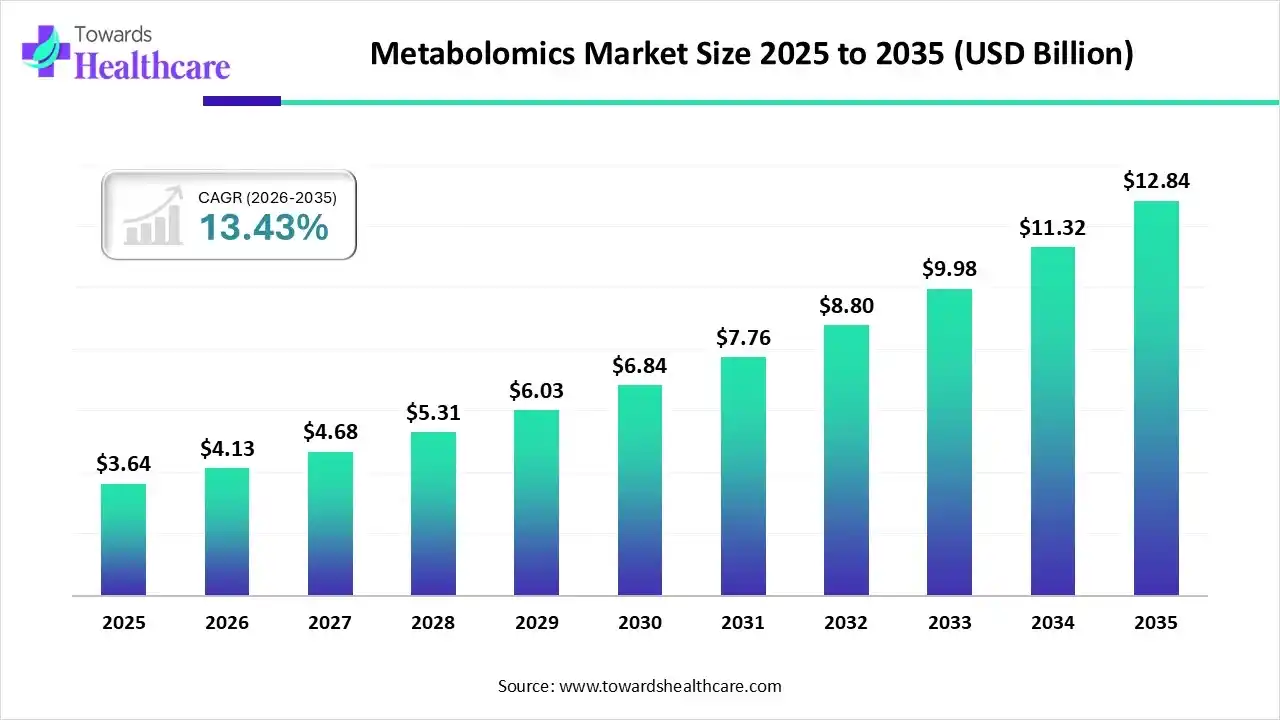
The global metabolomics market was evaluated at US$ 3.64 billion in 2025 and is expected to reach around US$ 12.84 billion by 2035, growing at a CAGR of 13.43% from 2026 to 2035.
The metabolomics market has grown rapidly as a result of metabolomics, which combines techniques to identify and analyze cellular metabolites using advanced analytical methods with statistical and multivariate methods for data extraction and interpretation. Significant investments have been made in the development of analytical methods for different cellular products such as gene expression (transcripts), proteins, and metabolites. This method has been applied to many different biological systems using GC-MS, including plant, microbial, urine, and plasma. Metabolomics uses additional studies such as LC-MS/MS, GC-MS, and/or NMR to identify and characterize as many metabolites as possible. It can also be used for metabolic fingerprints (or footprints of exogenous and/or secreted metabolites).
Metabolomics refers to the systematic study of small molecules and metabolites present in biological systems to understand metabolic changes, identify biomarkers, and support disease research and drug development. The track and trace solution market is growing as laboratories increasingly need accurate identification and monitoring of biological samples, reagents, and analytical materials throughout complex workflows. Key trends include barcode-based sample identification, RFID tagging, digital chain-of-custody systems, cloud-based tracking, and automated inventory management. Technological advancements in artificial intelligence, laboratory automation, IoT, and advanced analytics are improving sample traceability, data integration, and workflow accuracy. Major drivers include growing metabolomics research, increasing sample volumes, complex laboratory processes, rising demand for reproducible results, and the need to reduce sample mix-ups. Future opportunities include AI-powered sample tracking, smart laboratory systems, predictive inventory management, automated workflow monitoring, and inventory platforms connecting research laboratories, pharmaceutical companies, biotechnology firms, and academic institutions for more efficient operations.
Driver
Advancing Biotechnology
Metabolomics is increasingly recognized as an important enabler in biotechnological advances, bridging the gap between genotype and phenotype to provide a deeper understanding of cellular function. Its applications cover a wide range of areas, including phenotyping genetically modified plants, testing genetic diversity, determining gene function, and monitoring responses to biotic and abiotic stresses. Metabolomics not only helps discover new biological insights by identifying significant changes in metabolites but also supports the development of new biotechnological solutions. Analysis and data mining of metabolomics datasets can generate new perspectives for biotechnology and discover new targets, thereby accelerating the growth of the metabolomics market. This industry expansion highlights the importance of metabolomics in fields such as agriculture, health research, and the biotechnology industry, making it an important tool for future scientific and technological advancement.
Restraint
Challenges in Biomarker Identification
The biggest limitation to the growth of the metabolomics market is the difficulty associated with identifying biomarkers needed to understand changes in the body. This step is also important in metabolomics studies, as metabolite identification (especially from LC-MS data) is more difficult as libraries are not re-developed compared to GC-MS analysis. Furthermore, inconsistencies in analytical platforms, column types, gradients, and collision energies used in tandem mass spectrometry in the laboratory further complicate data comparison and reproducibility. These economic barriers hinder the general application and activation of metabolomics, making it difficult for the industry to grow and fully realize its potential across the market.
Opportunity
Advancing Nutrition Intervention
In recent years, the use of metabolomics in nutrition research has increased, leading to advances in personalized nutrition and public health research. These studies investigate the link between diet and health or disease, and the diet is related to the use of whole foods, specific foods, or products such as micronutrients or phytochemicals. However, measuring the impact of these interventions can be challenging because metabolic changes are so subtle and often difficult to detect. Metabolomics plays an important role in overcoming these challenges, identifying target biomarkers of dietary intake, developing personalized nutrition strategies, and supporting large-scale research studies to better understand the relationship between nutrition and health. Therefore, developing metabolomics applications in these areas will not only improve understanding of the role of nutrition in health but also create a significant time for the growth of the metabolomics market, positioning it as a leader in the field of nutrition, a key enabler of health innovation.
| Key Elements | Scope |
| Market Size in 2026 | USD 4.13 Billion |
| Projected Market Size in 2035 | USD 12.84 Billion |
| CAGR (2026 - 2035) | 13.43% |
| Leading Region | North America |
| Historical Data | 2020 - 2023 |
| Base Year | 2025 |
| Forecast Period | 2026 - 2035 |
| Measurable Values | USD Millions/Units/Volume |
| Market Segmentation | By Product and Service, By Application, By Indication, By End-user, By Geography |
| Top Key Players | Thermo Fisher, Agilent, Metabolon, Shimadzu Corporation, Bruker, Waters Corporation, Biotree, LECO Corporation, Biocrates Life Sciences AG, Human Metabolome Technologies, Metware, Applied Protein Technology, Creative Proteomics, Diagnostic Solutions Laboratory |
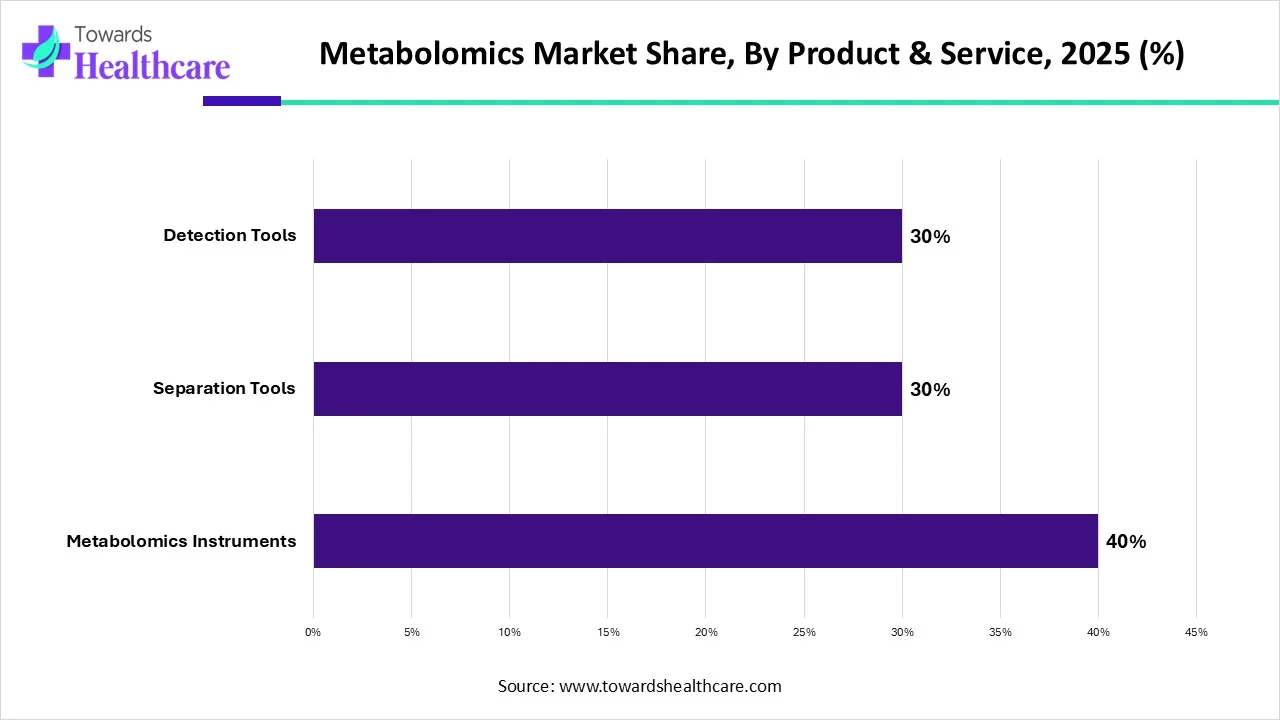
| Segments | Shares % |
| Metabolomics Instruments | 40% |
| Separation Tools | 30% |
| Detection Tools | 30% |
Explanation
Why Did the Metabolomics Instrument Segment Dominate in the Metabolomics Market?
By product & service, metabolomics instrument segments constitute the metabolomics market by 40% as they allow researchers to analyze non-volatile compounds without the need for derivatization to increase volatility, reduce the formation of fragment ions, and simplify the spectral description of complex compounds. While the bioinformatics tools and services segment is the fastest growing in the forecast period due to its ability to process raw spectral data, analytical analysis to identify major metabolites has potential nature linkages with metabolite data for metabolite identification and bioinformatics analysis.
Metabolomics combined with sophisticated bioinformatics analysis and with the application of mathematical modeling can generate a metabolic snapshot of patients. This is done to classify patients into subpopulations and subgroups based on disease and risk. This helps narrow down a list of individuals who require medical intervention and treatment.
| Segments | Shares% |
| Biomarker Discovery | 35% |
| Drug Discovery | 20% |
| Toxicology Testing | 10% |
| Nutrogenomics | 5% |
| Functional Genomics | 5% |
| Personalized Medicine | 15% |
| Others | 10% |
Explanation
How the Biomarker Discovery Segment Dominated the Metabolomics Market?
By application, the biomarker discovery segment held the largest share of the market by 35% in 2025. The utilization of metabolic biomarkers to test pathophysiological health status for patients has increased in several years, this acts as a major growth factor for the segment to expand. Moreover, the integration of advanced technologies and advancements in metabolomics are seen to promote the segment’s growth.
| Segment | Share 2025 (%) |
| Cancer | 40% |
| Cardiovascular Disorders | 20% |
| Neurological Disorders | 10% |
| Metabolic Disorders | 15% |
| Others | 15% |
Explanation
Which Indication Type Segment Held the Dominating Share of the Metabolomics Market?
By indication, the cancer segment led the metabolomics market in 2025, with the rising demand for advanced testing methods or detection methods for cancer is observed to sustain the segment’s growth during the forecast period. Moreover, the rising number of cancer therapies and rising number of cancer patients are major factors to promote the growth of the segment. Additionally, the increase in funding for cancer and other associated diseases studies is observed to expand the segment’s growth in the upcoming period.
| Segments | Shares % |
| Academic and Research Institutes | 40% |
| Pharmaceutical and Biotechnology Companies | 30% |
| Contract Research Organizations | 30% |
Explanation
What Made Academic and Research Institutes the Dominant Segment in the Metabolomics Market?
By end user, the academic and research institutes segment dominates the metabolomics market by 40%, as there is great potential for metabolomics to be used in public research to assess the effects of nutrients, drugs, and environmental impacts. The pharmaceutical and biotechnology companies segment is fastest growing, as mass spectrometry-based metabolomics plays an important role in clinical research, disease treatment, medicine, animal research and plants, agricultural research, and food. Research methods include sample preparation, sample analysis, data analysis, and metabolic process analysis.
North America dominated the metabolomics market due to growth in the R&D investment, which accelerated the metabolomics research. The presence of robust industries and advanced research infrastructure also increased their research and development for precision medicine development, where the adoption of advanced technologies also contributed to the market growth.
U.S. Metabolomics Market Trends
United States is steadily increasing by 7 to 8 million people every 5 years. Chronic diseases affect 50% of the population, and their care accounts for more than 85% of medical expenses. This has become an epidemic. Increase access to quality healthcare. Nearly 50% of US consumers now consider health the most important thing in their daily lives, an increase from 42%. Healthcare in the United States, unlike any other industry, is a complex stakeholder system comprised of patients, payers, and providers. The country’s more than 6,600 biotech companies are committed to innovation to solve complex medical problems and save more lives. Investments in the medical field are vital, driving the growth of the metabolomics market.
Canada Metabolomics Market Expands Through Advanced Life Sciences Research
Canada’s metabolomics market is growing due to increasing biomedical research, expanding genomics and proteomics activities, and rising demand for biomarker discovery. Strong academic research capabilities and growing collaboration between research institutions and biotechnology companies are supporting adoption. Increasing application in disease research, nutrition studies, and drug development is further encouraging the use of advanced metabolomics platforms and analytical technologies across Canada.
Asia Pacific is expected to grow significantly during the forecast period as healthcare providers in the region adopt more technologies, including AI and cloud technology, in their standards of care. Increasing healthcare spending in Asia Pacific is inevitable. The growth of the metabolomics market is driven by the increasing demand for medical devices in the Asia Pacific, which can be attributed to several factors, such as a rapidly aging population, the arrival of a growing middle class, health information, and key government initiatives, thus leading the growth of market.
Asia is expected to experience significant growth in the metabolomics market during the forecast period due to several factors. The increasing prevalence of chronic diseases, including cancer, diabetes, and cardiovascular conditions, is driving the demand for advanced diagnostic tools and personalized treatment approaches. Rapid advancements in healthcare infrastructure, particularly in countries like China and India, are further boosting research and development in metabolomics. The expansion of the pharmaceutical and biotechnology industries in the region is accelerating drug discovery and development. Additionally, the adoption of precision medicine, technological advancements in analytical techniques, and a growing focus on early disease detection are all contributing to the growth of the metabolomics market across Asia.
India’s Metabolomics Market Expands Through Growing Biomedical Research
India’s metabolomics market is notably expanding due to increasing life-science research, rising interest in precision medicine, and growing application in disease biomarker discovery. Expansion of biotechnology and pharmaceutical research in encouraging the adoption of advanced analytical platforms. Increasing academic research activities, improving laboratory capabilities, and greater focus on understanding disease mechanisms are further creating opportunities for metabolomics technologies across clinical and research applications.
China Metabolomics Market Trends
The rapid expansion of industries in China is increasing the R&D of metabolomics. At the same time, the growing healthcare investments, growing health awareness, and disease burden are also increasing their advancements. Moreover, the growing demand for personalized medicine is also driving the metabolomics growth.
Europe is expected to grow significantly in the metabolomics market during the forecast period, due to the presence of robust pharmaceutical and biotech industries, which is supporting the metabolomics research. The growing R&D investments and government funding are driving the drug discovery and biomarker research of metabolomics, promoting the market growth.
UK Metabolomics Market Trends
The growing research ecosystem in the UK and the presence of robust biotechnology and pharmaceutical companies are also increasing the interest in metabolomics. The growing advanced technologies, advancements in personalized medicine, and growth in government funding are also driving the metabolomics advancements.
Germany’s Metabolomics Market Advances Through Precision Research
Germany’s metabolomics market is significantly growing due to strong pharmaceutical and biotechnology research, advanced laboratory infrastructure, and increasing focus on precision medicine. The country’s established research ecosystems support wider use of metabolomics in biomarker discovery, drug development, and disease research. Growing adoption of high-resolution analytical technologies and collaborations between academic researchers are further strengthening market opportunities.
R&D
Clinical Trials and Regulatory Approvals
Packaging and Serialization
Distribution to Hospitals, Pharmacies
Patient Support and Services
Strengths
Weaknesses
Opportunities
Threats
By Product and Service
By Application
By Indication
By End-user
By Geography
Speak with a healthcare analyst about your research, consulting, or platform needs.




 sales@towardshealthcare.com