
Find the Right Market Report
Search thousands of industry reports, market insights, and research studies in one place.
Search thousands of industry reports, market insights, and research studies in one place.
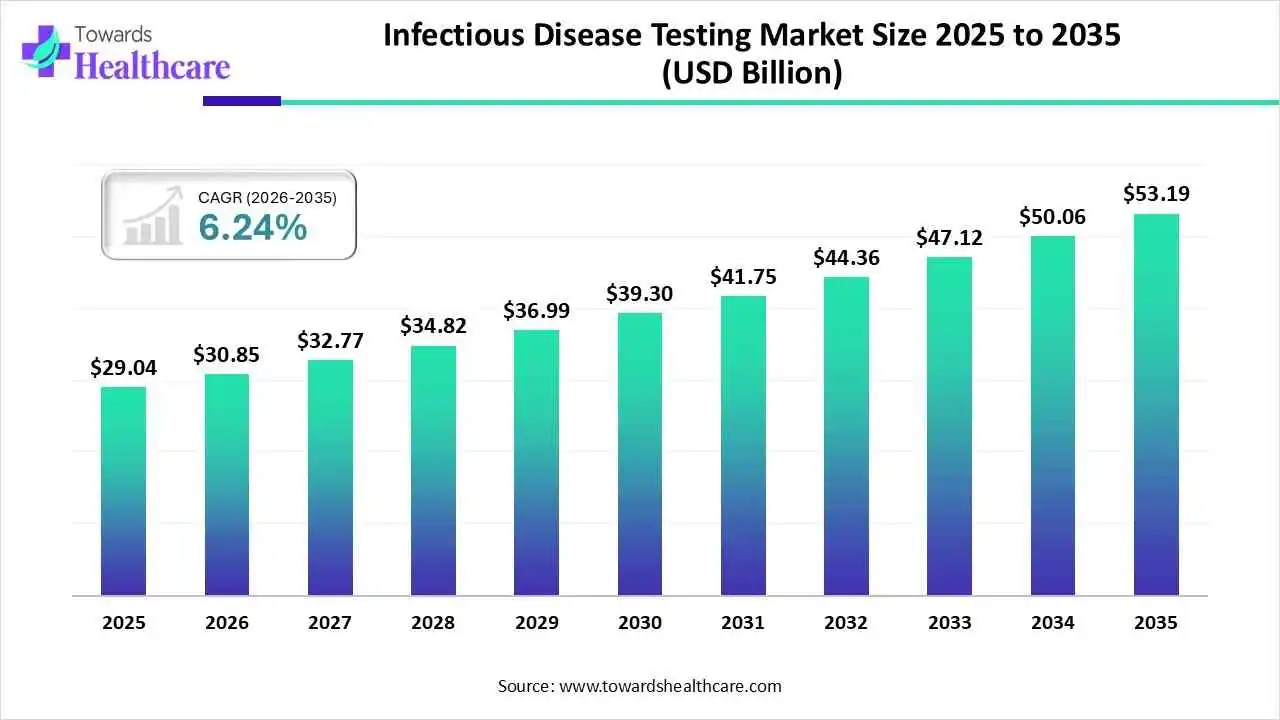
The global infectious disease testing market size is calculated at USD 29.04 billion in 2025, grew to USD 30.85 billion in 2026, and is projected to reach around USD 53.19 billion by 2035. The market is expanding at a CAGR of 6.24% between 2026 and 2035.
| Metric | Details |
| Market Size in 2026 | USD 30.85 Billion |
| Projected Market Size in 2035 | USD 53.19 Billion |
| CAGR (2026 - 2035) | 6.24% |
| Leading Region | North America |
| Market Segmentation | By Product & Services, By Technology, By End User, By Region |
| Top Key Players | Danaher Corporation, Abbott Laboratories, Bio-Rad Laboratories, Becton, Thermo Fisher Scientific, Biomérieux SA, Luminex, Diasorin, Roche Diagnostics, Dickinson and Company, Quidel, Meridian Bioscience, Siemens AG |
Infectious diseases can be caused by parasites, bacteria, and viruses, which can lead to rapid transmission and infection in humans as well as animals. Thus, for the control of these infections, various testing methods are being developed for their early diagnosis, isolation, and treatment. At the same time, new advancements for obtaining fast and accurate results are also being developed. Furthermore, to produce miniaturized, portable, and low-cost POC testing kits, materials science, microfluidics, nanotechnology, and micro-electro-mechanical systems (MEMS) technology are also being used. Thus, this enhances the speed, sensitivity, specificity, and efficiency of the tests.
Artificial intelligence (AI), as well as machine learning algorithms, can help in various processes to improve infectious disease testing. They help to identify the disease pattern, which can be further integrated with environmental factors, social behavior, and genomic information for predicting the infection outbreaks. At the same time, they also identify the infection and mortality rates, which can be used in predicting the spread and severity of the infections. Thus, all these factors improve the accuracy, speed, and multi-faceted analytical approach compared to the traditional methods.
Rising Infectious Diseases
There is a rise in infectious diseases with the rising population. At the same time, the increasing awareness about the early detection of these diseases is also rising within the population. Therefore, this in turn increases the demand for the use of early and fast testing approaches. This helps in the early identification of the causative agents, which in turn helps in delivering effective treatment strategies. Furthermore, various rapid diagnostics kits are also being used for the diagnosis and management of these diseases. Thus, all these factors drive the infectious disease testing market growth.
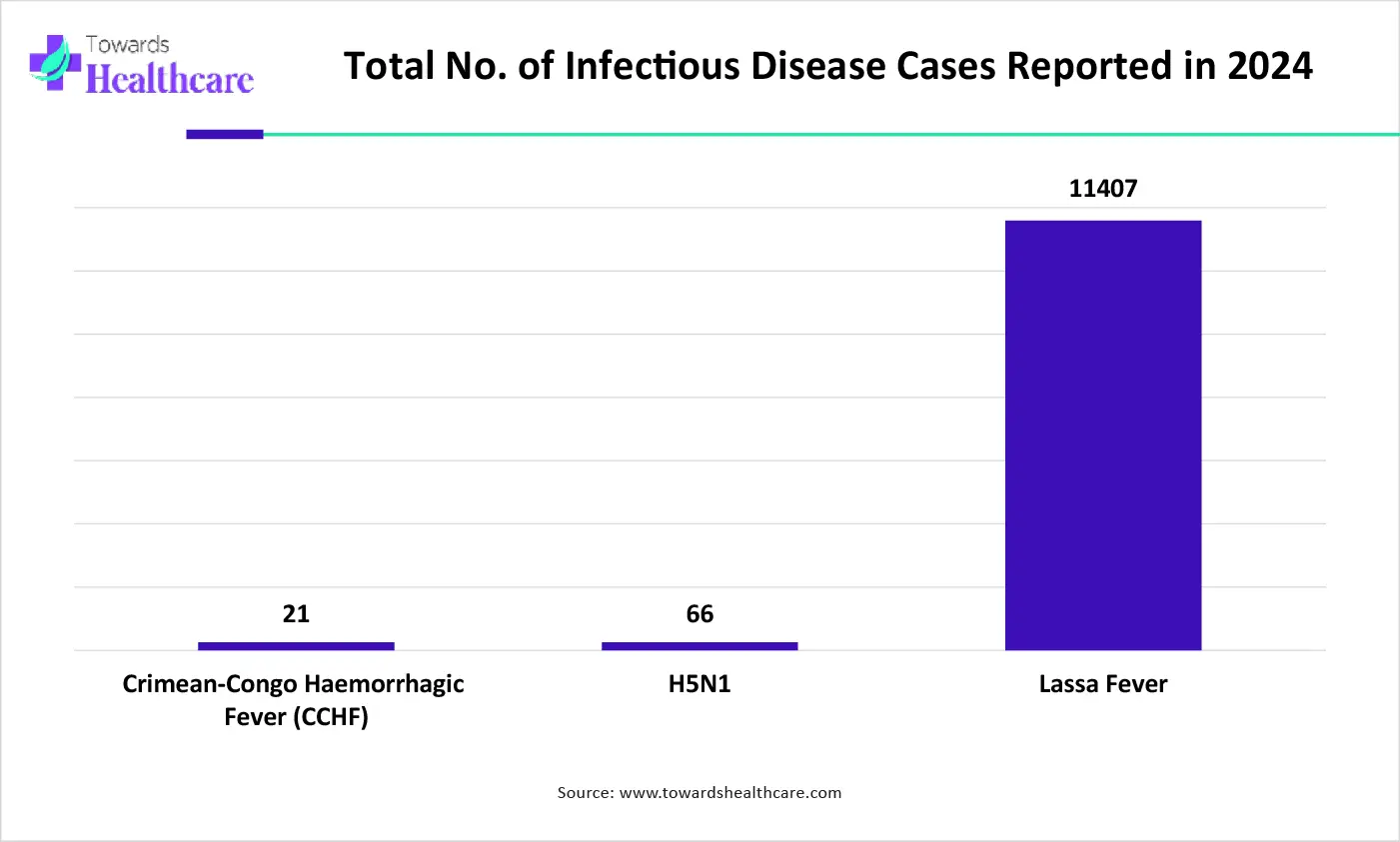
The graph represents the total number of infectious disease cases reported in year of 2024. It indicates that different types of infectious diseases are rising. Hence, it increases the demand for new infectious disease testing options for the effective management of these diseases. Thus, this in turn will ultimately promote the market growth. (Source - GOV.UK)
Inaccurate Diagnosis
The results obtained from the testing may lead to misdiagnosis, resulting in inaccurate disease testing. Similarly, the false positive results can lead to unnecessary treatment, or the false negative results can lead to progression of the disease without any treatment. This increases the dissatisfaction among the patients.
Rising Homecare Testing
The demand for the use of homecare testing is rising due to increasing chronic diseases, as well as geriatric patients. Therefore, by using these testing kits at home, patients can monitor and manage their health conditions. Furthermore, it also helps in reducing the number of hospital visits, which in turn, increases patient comfort. At the same time, various new advancements are also being made with the help of software for developing digital health platforms. Thus, all these factors promote the infectious disease testing market growth.
For instance,
By product & services type, the kits & reagents segment dominated the market in 2025. This segment dominated because the kits & reagents were used continuously in the development of various testing kits for different diseases. This contributed to the infectious disease testing market growth.
By product & services type, the software segment is estimated to be the fastest growing at a notable CAGR during the forecast period. The use of software is improving the accuracy as well as utilizing various other features, which help in enhancing the testing procedure.
By technology type, the DNA sequencing & NGS segment dominated the market in 2025. The segmental growth is attributed to the advancements in genomics and the need for studying disease progression. The DNA sequencing & NGS helped in the detection of various causative agents with rapid results. This enhanced the market growth.
By technology type, the PCR segment is anticipated to be the fastest growing during the forecast period. The PCR testing can also be used for smaller quantities of sample testing with fast and accurate results.
By end user, the hospitals/ clinical laboratories segment dominated the global infectious disease testing market in 2025. The hospitals/ clinical laboratories tested a large number of patients. At the same time, various new testing kits were also utilized. Thus, this promoted the market growth.
By end user, the academic research institutes segment is predicted to be the fastest growing during the forecast period. The academic research institutes are contributing to the rising research and development of various testing kits, along with AI integration.
North America dominated the infectious disease testing market in 2025. North America consisted of well-established healthcare sectors along with the presence of advanced technologies. This increased the use and production of infectious disease testing among the population. Thus, this contributed to the market growth.
North America benefits from advanced laboratories, strong surveillance, and widespread molecular testing. Multiplex PCR and rapid antigen platforms remain important. Demand is supported by respiratory infections and antimicrobial resistance concerns. Major competitors include Abbott, Roche, Danaher, and bioMérieux. Opportunities lie in decentralized testing, syndromic panels, and antimicrobial resistance testing. Integrated public health networks can further improve outbreak readiness across the region and strengthen rapid response capabilities.
The U.S. Infectious Disease Testing Market Trends
Due to advanced hospitals and industries, the demand for the use of rapid diagnostic approaches is increasing for the early detection of infectious diseases. At the same time, with the use of AI, new testing kits are also being developed.
US is strengthening infectious disease testing through provincial laboratories, public health programs, and improved molecular capacity. Respiratory infections, tuberculosis, and sexually transmitted infections support steady demand. Competitive activity includes multinational diagnostic companies and specialized laboratory providers. Opportunities include decentralized testing, rural access, and multiplex molecular panels. Remote communities create a strong need for portable systems and faster specimen transportation across provinces and underserved northern regions.
The Canada Infectious Disease Testing Market Trends
The industries in Canada are developing as well as increasing the manufacturing of testing kits due to rising demand. Furthermore, at-home testing is also contributing to the same, increasing their production rates.
Canada is strengthening infectious disease testing through provincial laboratories, public health programs, and improved molecular capacity. Respiratory infections, tuberculosis, and sexually transmitted infections support steady demand. Competitive activity includes multinational diagnostic companies and specialized laboratory providers. Opportunities include decentralized testing, rural access, and multiplex molecular panels. Remote communities create a strong need for portable systems and faster specimen transportation across provinces and underserved northern regions.
Asia Pacific is estimated to host the fastest-growing infectious disease testing market during the forecast period. Asia Pacific is facing a rise in infectious diseases, which in turn is increasing the demand for infectious disease testing. This is also supported by the government, which enhances the market growth.
For instance,
The China Infectious Disease Testing Market Trends
China has a large population, due to which there is a rise in infectious disease cases. Thus, the industries as well as the hospitals are adopting various technologies for improving the testing conditions.
China has substantial testing demand from viral hepatitis, tuberculosis, syphilis, influenza, and other infections. In December 2025, authorities reported 7.24 million notifiable infectious disease cases. Domestic companies compete with global suppliers across molecular and immunoassay platforms. Growth opportunities include hospital automation, rapid molecular testing, and regional laboratory expansion. Government disease-control programs continue to support diagnostic infrastructure and screening capacity nationwide through stronger surveillance networks.
The India Infectious Disease Testing Market Trends
The advancing healthcare in India, along with rising infectious diseases, is utilizing as well as developing new rapid diagnostic kits for their early detection. Furthermore, to make them affordable, the government is also providing its support.
India offers strong opportunities because infectious diseases remain a major public health burden. Tuberculosis is especially important, while malaria and respiratory infections also sustain testing demand. Domestic manufacturers compete with global firms. Growth areas include affordable molecular tests, mobile laboratories, decentralized screening, and faster sample transport for rural populations and remote healthcare centers.
Europe is expected to grow significantly in the infectious disease testing market during the forecast period. The industries and institutes in Europe are developing various new approaches for enhancing the testing of infectious diseases. This, in turn, promotes the market growth.
Europe has mature diagnostic infrastructure and growing demand for rapid molecular testing. Antimicrobial resistance, respiratory infections, tuberculosis, and emerging pathogens remain priorities. Regional laboratories increasingly use multiplex platforms and decentralized systems. Roche, bioMérieux, Abbott, and Danaher maintain strong competitive positions. Opportunities include antimicrobial resistance panels, surveillance testing, and cross-border outbreak preparedness. EU health programs can support laboratory modernization and harmonized testing practices across member states.
The Germany Infectious Disease Testing Market Trends
The research and development sectors in industries and institutes are focused on manufacturing various kits for different infection detection. Moreover, with the help of AI digital platforms for accurate testing is also being invented.
Germany has a strong laboratory network and high adoption of advanced diagnostic technologies. Hospitals are increasing use of molecular assays for respiratory infections, tuberculosis, and antimicrobial resistance. Established companies compete with specialized diagnostic developers. Opportunities include multiplex PCR, rapid hospital testing, and laboratory automation. Germany’s focus on healthcare quality and infection control supports demand for reliable diagnostics, while reimbursement and procurement rules influence product adoption significantly.
The UK Infectious Disease Testing Market Trends
In the UK, the industries as well as the institutes are collaborating to enhance the development of rapid testing kits, which can be used in hospitals as well as at home. Furthermore, they are also supported by the government and regulatory bodies.
The UK is expanding infectious disease testing through NHS laboratories, surveillance programs, and centralized public health capabilities. Respiratory infections, sexually transmitted infections, and antimicrobial resistance remain important applications. The country is also strengthening preparedness for emerging pathogens. Competition includes global diagnostic manufacturers and specialized suppliers. Growth opportunities include point-of-care testing, molecular panels, and faster community diagnostics, particularly where reduced laboratory turnaround can improve treatment decisions.
Growing Research Activities to Drive Middle East & Africa
The Middle East & Africa are considered to be a significantly growing area, due to the rising prevalence of infectious diseases and growing awareness of screening and early diagnosis of infectious diseases. The growing research and development activities lead to the development of novel diagnostic approaches for infectious diseases. Technological advancements drive the latest innovations in infectious disease testing in the Middle East & Africa.
UAE Market Trends
In June 2025, researchers from the New York University Abu Dhabi (NYUAD) launched a paper-based diagnostic tool, the Radially Compartmentalized Paper Chip (RCP-Chip), to detect infectious diseases in under 10 minutes. The device was initially developed to detect COVID-19, but can also detect other diseases, such as chickenpox, dengue, and malaria. (Source: Times of India)
South Africa
The incidence rate of TB in South Africa is 468 per 100,000 population. The National Institute for Communicable Diseases assists South African healthcare workers, policy makers, and the general public in providing science-based, up-to-date information related to communicable diseases. It also provides specialized diagnostic services and supports disease control and elimination. (Source: NCID)
By Product & Services
By Technology
By End User
By Region
Speak with a healthcare analyst about your research, consulting, or platform needs.




 sales@towardshealthcare.com