
Find the Right Market Report
Search thousands of industry reports, market insights, and research studies in one place.
Search thousands of industry reports, market insights, and research studies in one place.
The global endotracheal tube market size was estimated at USD 2.19 billion in 2025 and is predicted to increase from USD 2.34 billion in 2026 to approximately USD 4.24 billion by 2035, expanding at a CAGR of 6.84% from 2026 to 2035.
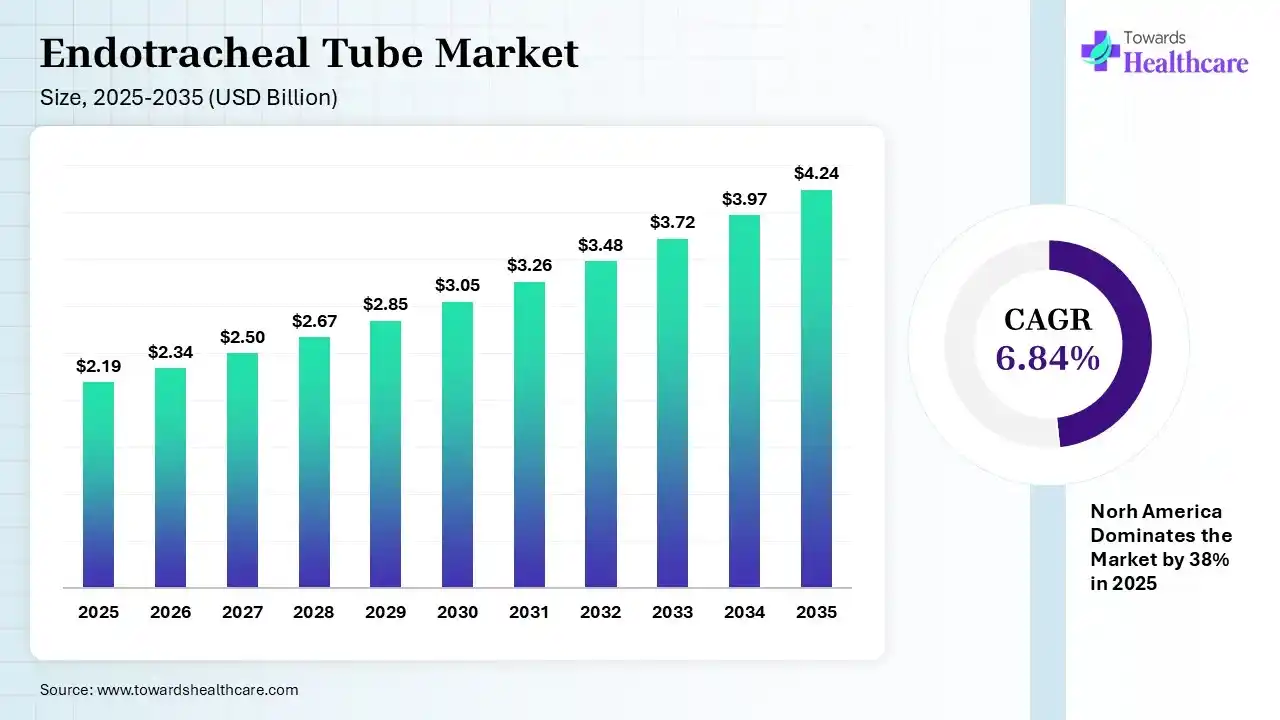
Day by day, the world is facing a massive growth in diverse respiratory diseases, like asthma, COPD, and COVID-19, rising surgical procedures, and the surging emergencies are demanding advanced endotracheal tubes. Novelty has inclined towards antimicrobial coatings, sensor-based technologies, and pediatric measures.
Firstly, the use of a flexible plastic, single-use tube inserted through the mouth or nose into the trachea to keep an open airway and deliver oxygen, often linked to a ventilator, is referred to as the endotracheal tube market. It has wider applications during surgeries, emergency medicine, or ICU care for patients who are facing difficulty in breathing on their own. Its widespread adoption is mainly propelled by increasing respiratory diseases, like COPD, asthma, COVID-19, the geriatric population, & growing surgical procedures, which need anesthesia.
.webp "Approximate Cases Per Year (In Million)")
An endotracheal tube is a flexible medical device inserted through the mouth or nose into the trachea to maintain open airways and support oxygen delivery or mechanical ventilation. Rising surgical procedures, respiratory disorders, emergency care requirements, and intensive care admissions are increasing demand. Greater adoption of cuffed products development. Expanding critical care infrastructure, pediatric airways management, and emerging healthcare facilities can create new demand. Improved materials, pressure-monitoring systems, visualization-assisted placements, antimicrobial coatings, and specialized tube design are enhancing safety and performance. Growing respiratory complications, increasing need for mechanical ventilation, rising surgical volumes, emergency airways management, and continuous improvements in airways management, and continuous improvements in airway devices are supporting the market’s expansion.
The Endotracheal tube market is influenced by internal factors such as product quality, material selection, tube design, cuff performance, manufacturing capabilities, innovation, and cost efficiency. Companies with strong research and development capabilities can introduce safer and more comfortable airway-management products. External factors include healthcare regulations, hospital infrastructure, surgical volumes, reimbursement conditions, economic factors, and healthcare expenditure. Rising respiratory disorders, increasing intensive-care admissions, emergency procedures, and demand for mechanical improvements in visualization-assisted placements, antimicrobial coating, pressure-monitoring systems, and specialized tube configurations are encouraging product adoption. However, stringent regulatory requirements, product adoption. However, stringent regulatory requirements, product-related complications, limited healthcare budgets, and competition from alternative airways-management devices may restrict expansion. Growing investments in critical-care facilities and increasing awareness of patient safety are expected to influence future demand and product development.
A very prominent advancement in the endotracheal tube is AI-enabled Videolaryngoscopy (VL), such as larynGuide & Frontier’s motorized VL, which leverages computer vision to find anatomical structures in real-time, & finally supports clinicians with navigation. The market has been spurring new technologies, including the Kepler Intubation System (KIS) & Remote Robot-Assisted Intubation System (RRAIS), for autonomous or semi-autonomous, quicker, and more precise tube placement.
Fostering Infection Control & Antimicrobial Technology
Firms are actively encouraging the reduction of VAP by employing antimicrobial-coated tubes, like AgION antimicrobial surface & specialized, subglottic secretion suctioning channels.
Spurring Material Innovation
Several manufacturers are transitioning towards thinner, stronger, and more flexible materials to facilitate excellent sealing, minimal mucosal injury, and better, more persistent performance.
Emphasizing Intelligent Cuff Pressure Systems
Researchers are putting efforts into sensors that offer consistent, real-time feedback to maintain correct cuff pressure (20–30 cmHâ‚‚O) automatically, which will mitigate tracheal necrosis or aspiration.
| Table | Scope |
| Market Size in 2026 | USD 2.34 Billion |
| Projected Market Size in 2035 | USD 4.24 Billion |
| CAGR (2026 - 2035) | 6.84% |
| Leading Region | North America by 38% |
| Key Applications | Mechanical ventilation, anesthesia delivery, airway management, emergency medicine, critical care, trauma care, surgical procedures |
| Primary End Users | Hospitals, Intensive Care Units (ICUs), Ambulatory Surgical Centers (ASCs), Emergency Departments, Military & Trauma Centers |
| Key Challenges | Pricing pressure, product commoditization, stringent regulatory requirements, hospital procurement consolidation, competition from low-cost manufacturers |
| Measurable Values | USD Millions/Units/Volume |
| Market Segmentation | By Product, By Route, By Application, By End Use, By Region |
| Top Key Players | Angiplast Pvt Ltd, Advin Health Care, Sterimed Group, ICU Medical, Inc., Medtronic (Covidien), Van Oostveen Medical B.V., Teleflex Incorporated, Convatec Inc., Fuji Systems Corp, SEWOON MEDICAL Co., Ltd. |
Which Product Dominated the Endotracheal Tube Market in 2025?
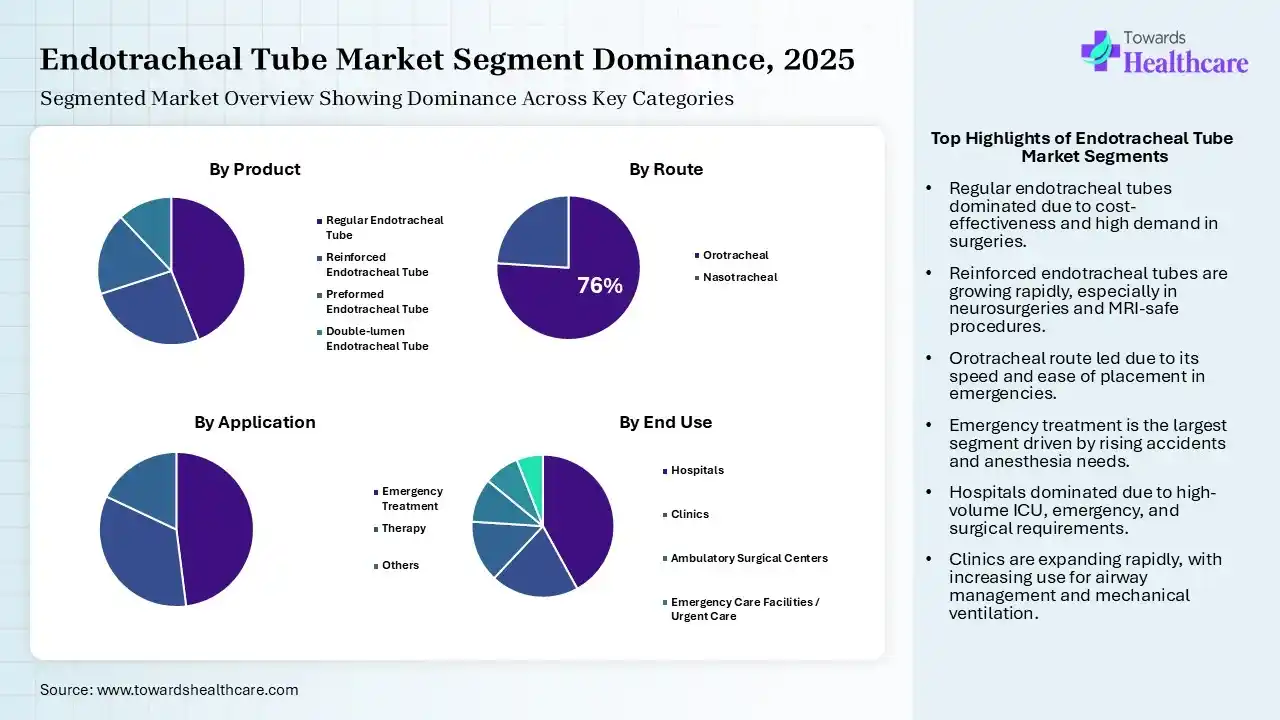
In 2025, the regular endotracheal tube segment held a major revenue share of the market by 44%. Globally surging demand for elective and emergency surgeries, which requires constant use of standard ETTs. Also, this type of tube is preferred in emerging areas, as it is cost-effective compared to advanced, coated, or specialized variants. They are usually developed by using soft, thermo-sensitive materials that conform to the patient's anatomy for increased comfort & better fit.
Reinforced Endotracheal Tube
Moreover, the reinforced endotracheal tube segment is predicted to expand fastest. This plays a vital role in preventing kinking/compression during neurosurgery, prone positioning, or head/neck surgeries. The trend is focusing on the progression of titanium-alloy helical wire-reinforced tubes, which enable safe use during magnetic resonance imaging, eliminating the heating and artifact concerns of traditional stainless steel. Specialized designs, like reinforced rescue tubes, are coupled with laryngeal mask airways (LMAs), & they offer flexible construction & specialized connectors for difficult airways.
How did the Orotracheal Segment Lead the Endotracheal Tube Market in 2025?
The orotracheal segment captured the largest share of the market by 76% in 2025 and is anticipated to expand at a rapid CAGR. Its dominance is fueled by its priority in emergencies, trauma, and anesthesia due to its pace and ease of placement compared to other routes. Surgeons are implementing specialized bougies & stylets to enhance speed and success in difficult conditions. This route overcomes nasal bleeding, sinus infections, and damage to turbinates.
Why did the Emergency Treatment Segment Dominate the Market in 2025?
In 2025, the emergency treatment segment held the biggest share of the market by 48% and is estimated to witness rapid growth. The globally accelerating number of accidents and injuries, with other cardiovascular and orthopedic issues, is driving the need for rapid, reliable airway management and general anesthesia, which relies on ETTs. The era is aiming at rising first-pass success rates (FPS), boosting oxygenation during the procedure, and lowering complications, such as esophageal intubation & hypoxia.
Which End Use Led the Endotracheal Tube Market in 2025?
The hospitals segment registered dominance in the market by 42% in 2025. Hospitals hold a high-volume ICU, emergency, and surgical requirements, which fuel demand for these endotracheal tubes. Hospitals are widely using double-lumen tubes for independent lung ventilation during thoracic surgery, or armored tubes that avoid kinking in head & neck surgeries. Alongside, hospitals are encouraging subglottic secretion drainage (SSD-ETT), which minimizes the risk of ventilator-associated pneumonia (VAP) and the requirement for or time spent on mechanical ventilation.
Clinics
Furthermore, the clinics segment is predicted to expand rapidly. Clinics are increasingly using an endotracheal tube in the operating room (OR) to manage the airway and in the ICU for prolonged mechanical ventilation in patients with respiratory failure. Besides this, ETTs have a crucial role in emergency, rapid-sequence intubation (RSI) to secure airways in cases of trauma, cardiac arrest, or unconsciousness (GCS < 8). In the case of pediatric & neonatal care, clinics are leveraging specialized, uncuffed tubes, particularly for premature babies or infants with respiratory obstruction.
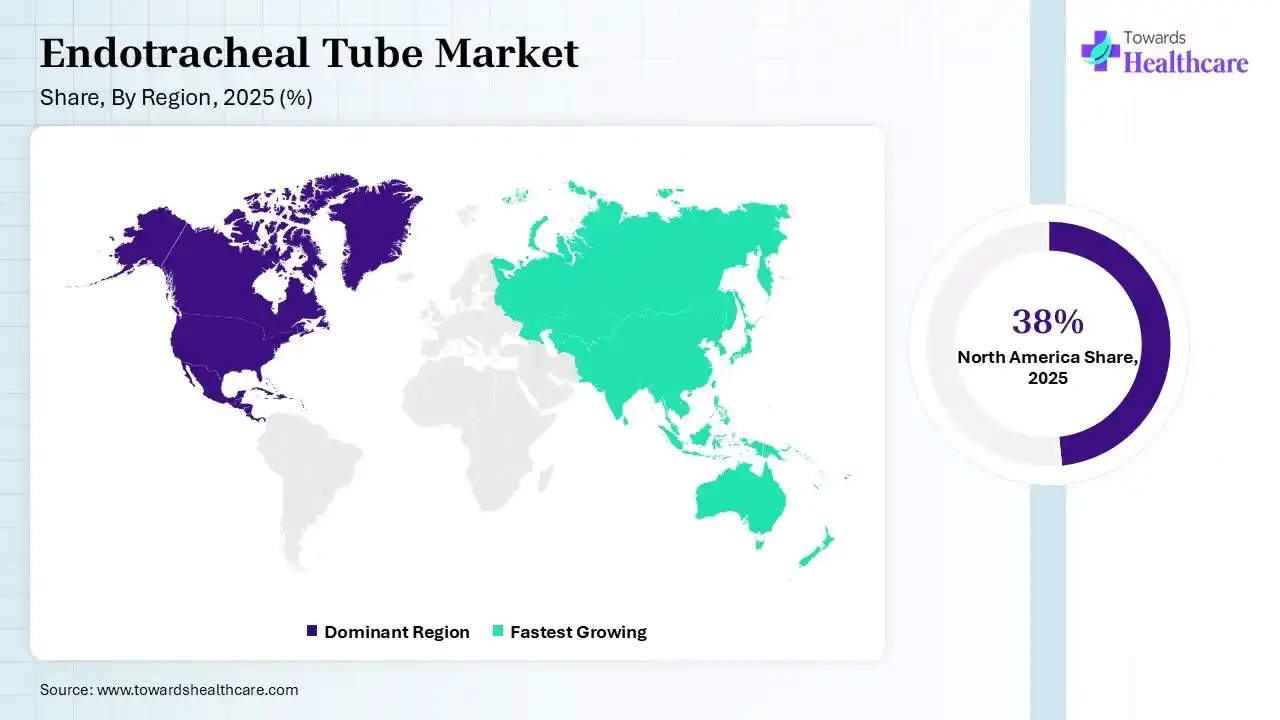
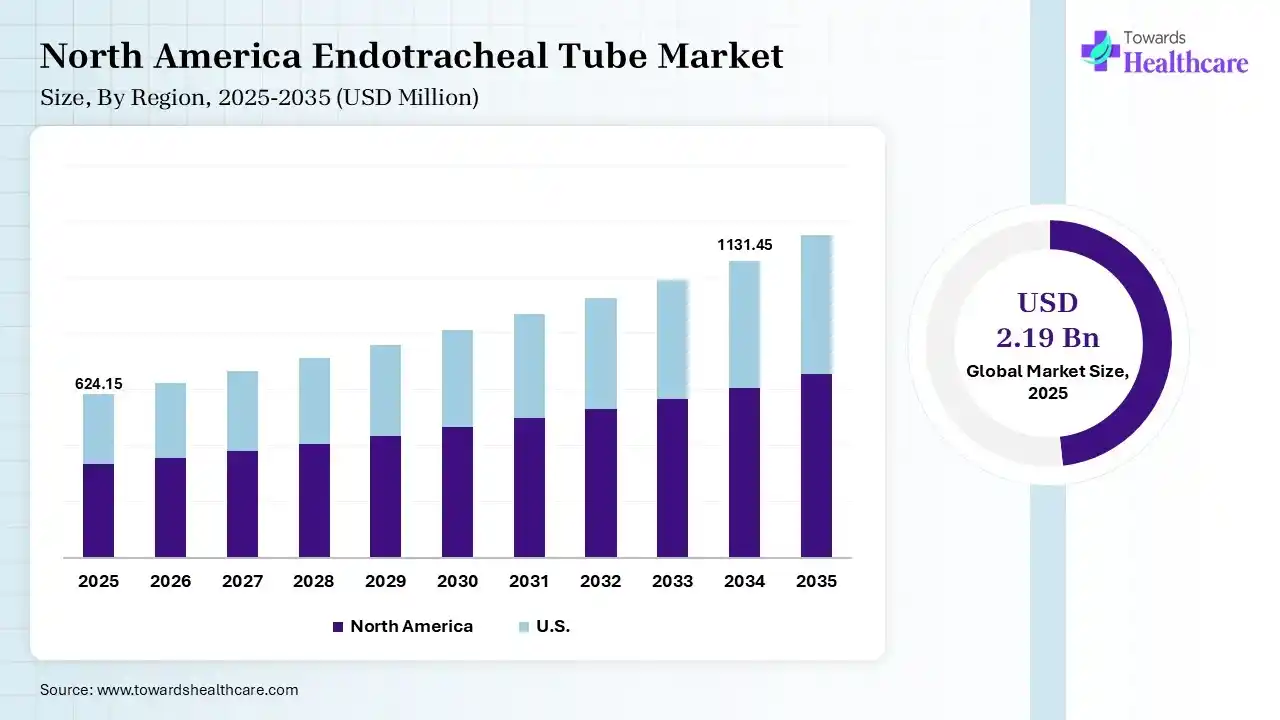
In 2025, North America led the endotracheal tube market by 38% share due to the rising cases of chronic obstructive pulmonary disease (COPD), bronchitis, & asthma. Also, the region has been stepping towards surging awareness and stringent protocols to prevent VAP, which results in higher use of advanced, most often single-use tubes. The region has implemented novel guidelines, i.e., 2025 Difficult Airway Society guidelines, which focus on video laryngoscopy as a first-line, superior tool to raise first-attempt success and lower complications.
U.S. Market Trends
Alongside, the U.S. was the largest contributor to the market, where numerous manufacturers are unveiling ETTs with united micro-sensors for real-time monitoring of cuff pressure, tracheal temperature, & locating to combat complications. Also, recently, a study has shown that ultrasound-guided subglottic diameter measurement is a rigorous method for selecting ETT sizes in children.
Canada Strengthens Its Endotracheal Tube Market
Canada is significantly growing in the endotracheal tube market due to increasing surgical procedures, expanding critical-care services, and rising demand for advanced respiratory support. Growing prevalence of respiratory conditions is supporting the need for effective airways-management devices. Investments in modern hospital infrastructure and improvements in intensive-care facilities are encouraging adoption. Technological advancements in tube design, materials and patient-safety features are further supporting product development and creating opportunities for manufacturers across Canada.
Asia Pacific is predicted to expand fastest in the endotracheal tube market, as it is experiencing a massive rise in geriatric populations, mainly in Japan, South Korea, and China, which leads to increased chronic disease prevalence. Besides this, consistent investment in ICU beds and in countries, including India and China, is impelling demand. More specifically, the Japanese government has widened investment in healthcare technology, such as airway management, with substantial allocations for advancing ICU infrastructure.
China Market Trends
However, certain Chinese manufacturers, such as Well Lead Medical and Shenzhen Huixinnuo Technology, are rising their market footprint with competitive pricing & enhanced quality in the sterile ETT area. Chinese researchers conducted a study of the analysis of 98 different ETTs from 7 brands, which has shown differentiations in Mark-Tip and Mark-Cuff distances across brands.
India Emerges as a Fast-Growing Hub for Endotracheal Tube Innovation
India is significantly growing in the endotracheal tube market due to increasing surgical procedures, rising respiratory conditions, and expanding intensive-care infrastructure. Growing healthcare accessibility in increasing demand for reliable airway-management devices across hospitals. Improvements in critical-care facilities and emergency services are supporting product adoption. Rising awareness of advanced respiratory support and continuous development of safer, patient-focused tube design are further strengthening India’s growth opportunities in this sector.
| Ecosystem Segment | Representative Participants | Role in Market |
| Technology Providers | Medtronic, Teleflex, ICU Medical, Ambu | Develop airway management technologies and advanced ETT designs |
| Product Manufacturers | Medtronic, Teleflex, BD, ConvaTec, Well Lead Medical, Vygon | Manufacture standard and specialty endotracheal tubes |
| Service Providers | Cardinal Health, Owens & Minor, Medline | Distribution, logistics, procurement support |
| Platform Providers | ICU Medical, Vyaire Medical | Integrated respiratory care and ventilation platforms |
| CROs/CDMOs | Limited direct role | Market largely driven by in-house manufacturing |
| Software Vendors | ICU Medical, Vyaire Medical | Airway monitoring and ventilator integration software |
| Research Institutions | Academic medical centers, anesthesia research institutes, respiratory societies | Clinical evaluation, innovation, and validation |
| End-User Industries | Hospitals, ICUs, Surgical Centers, Emergency Medicine | Primary consumers of endotracheal tubes |
Sterilization & Packaging
Distribution to Hospitals & Clinics
| Tier 1 | Tier 2 | Tier 3 | |
| Market Share Influence Assessment | 68% | 22% | 10% |
| Tier 1 | ||||
| Company Name | Headquarters | Country | Why Relevant to This Market | Key Products/Services |
| Medtronic plc | Dublin | Ireland | Global leader in airway management and critical care devices | Shiley™ Endotracheal Tubes, SealGuard™ ETT |
| Teleflex Incorporated | Wayne, Pennsylvania | USA | Strong airway and anesthesia portfolio with global reach | Hudson RCI®, Sheridan® Endotracheal Tubes |
| ICU Medical, Inc. (Smiths Medical) | San Clemente, California | USA | Major airway management supplier following Smiths Medical acquisition | Portex® Endotracheal Tubes |
| Tier 2 | ||||
| Company Name | Headquarters | Country | Why Relevant to This Market | Key Products/Services |
| Vyaire Medical, Inc. | Mettawa, Illinois | USA | Strong respiratory care focus | AirLife™ Endotracheal Tubes |
| Intersurgical Ltd. | Wokingham, Berkshire | United Kingdom | Significant global airway management supplier | Endotracheal Tubes and Airway Accessories |
| Ambu A/S | Ballerup | Denmark | Strong anesthesia and airway management business | Single-use airway management devices |
| Tier 3 | ||||
| Company Name | Headquarters | Country | Why Relevant to This Market | Key Products/Services |
| Well Lead Medical Co., Ltd. | Guangzhou, Guangdong | China | Rapidly expanding global airway device supplier | Standard and Reinforced Endotracheal Tubes |
| Flexicare Medical Ltd. | Mountain Ash, Wales | United Kingdom | Specialist airway management manufacturer | Flexicare Endotracheal Tubes |
| Mercury Medical | Clearwater, Florida | USA | Focused airway management portfolio | Airway and respiratory care devices |
Strengths
Weaknesses
Opportunities
Threats
By Product
By Route
By Application
By End Use
By Region
.webp)
Speak with a healthcare analyst about your research, consulting, or platform needs.




 sales@towardshealthcare.com