
Find the Right Market Report
Search thousands of industry reports, market insights, and research studies in one place.
Search thousands of industry reports, market insights, and research studies in one place.
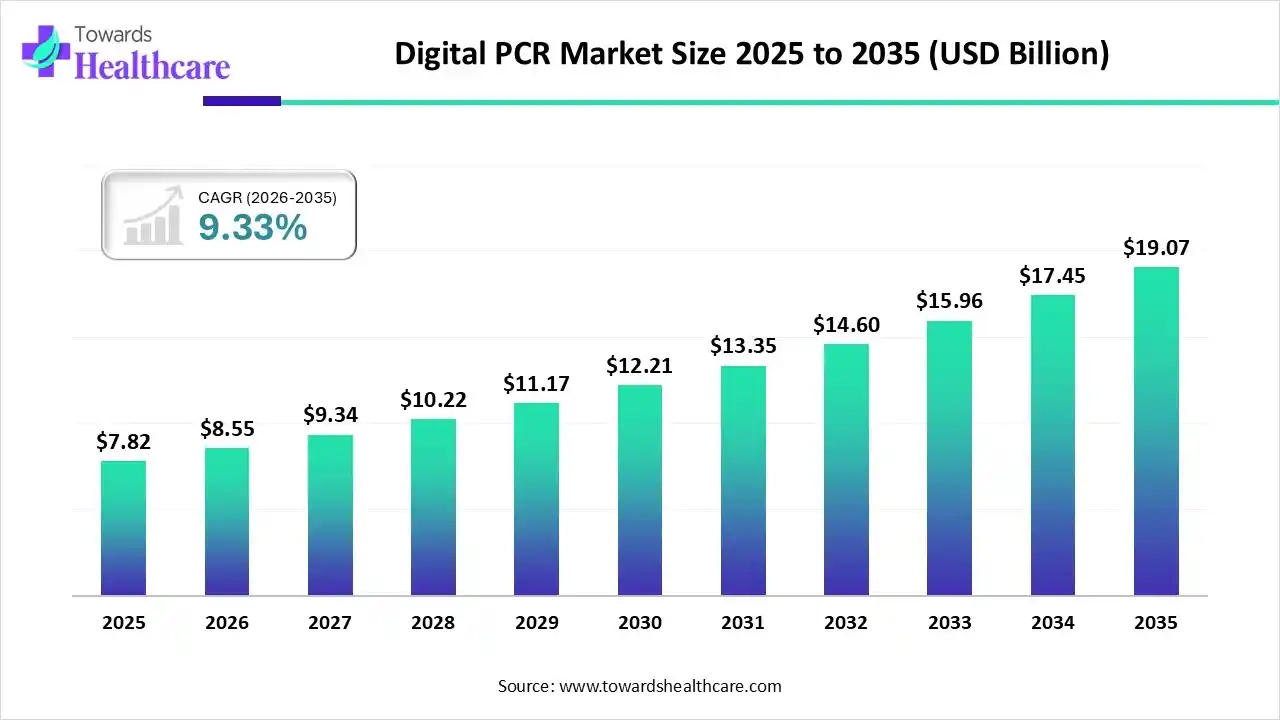
The global digital PCR market size was evaluated at US$ 7.82 billion in 2025 and is expected to attain around US$ 19.07 billion by 2035, growing at a CAGR of 9.33% from 2026 to 2035.
The digital polymerase chain reaction (dPCR) is considered the third generation of polymerase chain reaction (PCR) because it allows direct, precise, and accurate measurement of the target sequences, so the digital PCR market is growing rapidly. dPCR has proven to be particularly important for accurate diagnosis and measurement of the composition of nucleic acids, demonstrating its advantages in cancer diagnosis, prediction of relapse, and minimal disease maintenance, often combined with next-generation splicing. Digital polymerase chain reaction (dPCR) in cancer research is a novel technology.
The development of electronic digital polymerase chain reaction (dPCR) instruments has led to the expansion of the digital PCR market. Unlike traditional PCR, dPCR uses a water-oil emulsion system to disperse the sample into thousands of nanoliter-sized droplets, resulting in non-uniformity. This method requires small sample and reagent volumes, thus reducing cost and resource usage, making it particularly suitable for high-throughput applications. In any case, dPCR's ability to reduce error rates and address issues such as PCR inhibitors and changes in optimization further increases its repeated appeal. These factors and their clinical, environmental, and agricultural performance make dPCR a more accurate and convenient alternative to PCR methods, encouraging economic development.
Artificial intelligence is being used to prove several steps in the digital polymerase chain reaction process. AI is being deployed to predict the outcomes of dPCR experiments during the experiment design stage, with machine learning algorithms being used to suggest more effective optimal primers and reaction conditions. AI-based tools are also deployed to increase throughput screening processes, especially large data sets, more efficiently. Researchers have used MATLAB environment scripts to generate artificial digital PCR images and match the dPCR results.
This was done by generating images using a set of parameters, including targets, background fluorescence distribution, intensity, etc., and then generating chip images based on layout design or pattern recognition algorithms. The images are then used to train the image processing algorithms based on other customizable parameters. Artificial intelligence is also being employed to improve the detection and quantification of nucleic acids. Integrating these new technologies into crdPCR is likely to lead to further breakthroughs in next-generation PCR targeting absolute micro-analysis.
Recent advances in droplet digital PCR (ddPCR) technology, represented by the Bio-Rad QX600 droplet digital PCR system, create significant opportunities for commercial digital PCR. The QX600 platform can use up to 6 fluorophores simultaneously to measure up to 12 targets in a single well, enabling increased throughput and data collection. This capability is essential for many high-impact applications, including oncology research, gene expression analysis, next-generation sequencing (NGS) orthogonal assay, and cell and gene therapy biomarker discovery.
Additionally, the platform’s accuracy and sensitivity enhance resource utilization by aiding in collecting critical samples such as circulating tumor DNA (ctDNA). While ddPCR technology continues to offer the highest demand, throughput, and specificity, it drives digital PCR development and innovation, opening new doors for clinical and commercial expansion, particularly in oncology, genetic research, and environmental testing, driving growth and innovation within the digital PCR market.
Despite the advantages of droplet digital PCR (dPCR), several operational challenges and operational constraints have restrained the digital PCR market growth. Droplet content and shape variations can negatively impact the strength and reproducibility of ddPCR results, compromising reliability. The ddPCR system has many instruments, such as generators, thermocyclers, and droplet readers, that take up much lab space and require human training to operate properly. This process is time-consuming and cumbersome, involving multiple dispensing and transfer steps, increasing the risk of contamination and human error. In addition, the data quality can be affected by leakage coalescence or drift, which is often caused by thermal oscillations during amplification. These challenges and potential sources of error can limit the widespread use of ddPCR technology and hinder its commercial expansion.
| Table | Scope |
| Market Size in 2026 | USD 8.55 Billion |
| Projected Market Size in 2035 | USD 19.07 Billion |
| CAGR (2026 - 2035) | 9.33% |
| Leading Region | North America |
| Key Applications | Oncology, Genetic Testing, Infectious Disease Diagnostics, Liquid Biopsy, Cell & Gene Therapy, NGS Validation, Rare Mutation Detection, Environmental Testing, Food Safety, Forensic Science |
| Primary End Users | Clinical Laboratories, Hospitals, Academic & Research Institutes, Pharmaceutical & Biotechnology Companies, CROs, Public Health Laboratories |
| Key Challenges | High instrument costs, workflow complexity, assay standardization, reimbursement limitations, regulatory compliance, shortage of skilled molecular diagnostics professionals |
| Measurable Values | USD Millions/Units/Volume |
| Market Segmentation | By Type, By Products, By Indication, By End-user, By Application, By Geography |
| Top Key Players | QIAGEN, Thermo Fisher Scientific Inc., Bio-Rad Laboratories, Inc., JN Medsys, Stilla, Sysmex Corporation, Standard BioTools Inc., Precigenome LLC. |
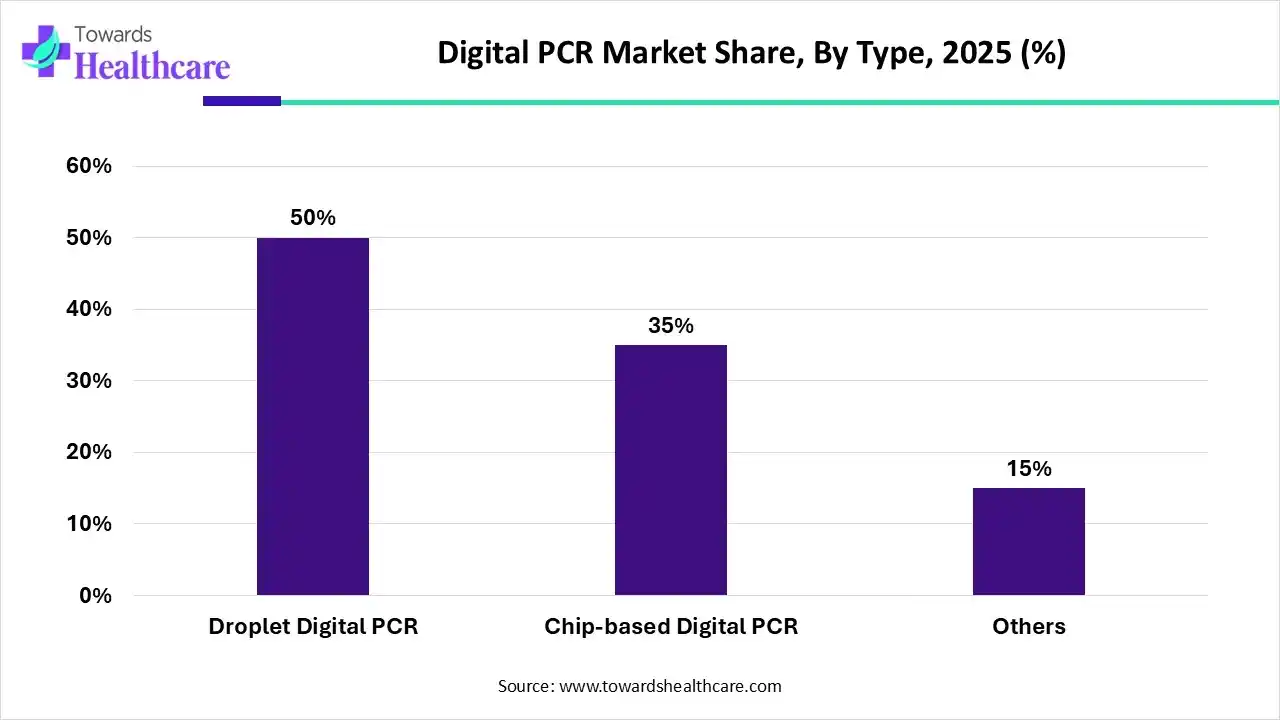
The Droplet dPCR Segment Led the Market in 2025
By type, the droplet dPCR segment held the highest market by 50% share due to the ddPCR technology increasing the efficiency by using lower sample and reagent volumes and reducing the overall cost while maintaining high accessibility and sensitivity compared to other PCR methods. The chip-based segment is projected to expand at a moderate CAGR during the forecast timeframe as it is rapidly partitioning. Use small amounts of samples and reagents. Multiple events can be accommodated in a single instrument.
| Segment | Share 2025 (%) |
| Instruments | 45% |
| Reagents & Consumables | 35% |
| Software & Services | 20% |
The Instruments Segment Led the Market in 2025
Based on product, the instruments segment accounted for the largest global digital PCR market by 45% share because it helps control the temperature required for the denaturation, annealing, and extension steps of the PCR process, thereby achieving positive results for DNA or RNA. The reagents and consumables segment is expected to grow at the highest CAGR during the forecast period.
The Genetic Disorders Segment Dominated the Market in 2025
Based on indication, the genetic disorders segment dominated the market by 40% and is expected to expand at a moderate CAGR during the forecast timeframe due to the increasing interest in dPCR based on Quantitative tools, especially in preclinical studies, which are used to detect genetics and precise measurements. The oncology segment is projected to expand at a substantial CAGR during the forecast timeframe, where dPCR enables rapid and accurate detection of oncogenic somatic mutations and CNVs, thereby helping translate and replicate statistical analysis to provide information about the changes leading to cancer.
Which End-User Segment Dominated the Market in 2025?
Based on end-users, the academic and research organizations segment held the largest market by 40% share due to the use of PCR in education, clinical research, and experimental design in diagnostic facilities. Academic and research organizations use digital polymerase chain reaction (dPCR) for various applications. At the same time, the clinical laboratories segment is projected to expand at the highest CAGR during the forecast timeframe as dPCR has entered the clinical arena and has applications in oncology, microbiology and epidemiology, genetics, and prenatal/newborn screening.
The Clinical Segment Dominated the Market in 2025
On the basis of application, the clinical segment led the market by 45% in 2025. The rising demand for accurate and precise alongside reliable nucleic testing in healthcare sector has promoted the expansion of the segment. The wide use of advanced clinical diagnostics in the clinical sector is observed to sustain the segment as a largest shareholder in the market. Moreover, as the research sector expands, the research segment is seen to grow rapidly.
According to regional insights, North America is dominated in the digital PCR market, accounting for over 40% of the global medical market. The medical device market in North America is experiencing significant growth and development due to key macroeconomic factors such as consumer preference for new products and technology, shift to healthcare solutions, special local conditions such as elderly and critical illnesses, and good governance health regulations and policies. The global medical technology industry is valued at over $567 billion annually.
U.S. Market Trends
As of March 2025, the U.S. Food and Drug Administration approved around 133 human genetic nucleic acid-based tests. The presence of key players, such as Thermo Fisher Scientific, Bio-Rad Laboratories, and Roche Diagnostics, majorly contributes to market growth.
The U.S. leads the digital PCR market through advanced molecular diagnostics and strong biotechnology research. The country has more than 7,000 hospitals supporting widespread adoption of advanced testing technologies. Pharmaceutical companies and research institutes increasingly use digital PCR for cancer research, infectious disease detection, and genetic analysis. Government funding, precision medicine initiatives, and continuous product innovation continue driving market expansion and clinical adoption nationwide.
Canada Market Trends
In March 2025, the Canadian government signed an agreement with Quebec to provide $305 million to support access to new and existing drugs, early diagnosis, and screening of rare diseases. The investment is a part of Quebec’s Action Plan for Rare Diseases 2023-2027. This encourages researchers to develop dPCR technologies for detecting rare diseases.
Canada is expanding the digital PCR market through growing investments in healthcare research and molecular diagnostics. The country has over 40 million people, increasing demand for accurate genetic and disease testing. Universities and biotechnology companies are strengthening research collaborations. Hospitals continue adopting advanced diagnostic technologies for oncology and infectious diseases. Government support for life science innovation and laboratory modernization encourages wider clinical and research applications nationwide.
Asia Pacific is expected to witness significant growth in the digital PCR market during the forecast period as medical devices play a significant role amidst the increasing demand for medical services in this region. The diversity in the region requires companies to identify each country. These include large markets like Japan and Australia, populous countries like China and India, and emerging markets like Malaysia and Thailand. The digitization of medical devices continues as OEMs digitize their equipment and operations. This digital revolution has not only forced medical technologists to use digital information to improve outcomes for doctors and patients but has also contributed to the emergence of new business models and related technologies.
China Market Trends
There are more than 4,000 healthcare startups in China. Out of 3,400 companies, 1670 companies collectively raised approximately $40 billion in venture capital and private equity. The life science sector in China saw 41 acquisitions and 114 IPOs in 2024.
China is witnessing strong growth in the digital PCR market through expanding biotechnology research and healthcare modernization. The country has more than 1.4 billion people, creating significant demand for advanced diagnostic technologies. Hospitals and research centers increasingly use digital PCR for cancer detection, infectious disease monitoring, and genetic testing. Government investments, growing pharmaceutical research, and expanding laboratory infrastructure continue supporting long-term market development across the country.
India Market Trends
In 2025, 193 digital PCR tenders were published by various tendering authorities and private companies in India. The Department of Biotechnology, by the Indian government, launched the GenomeINDIA Project, which underscores India’s scientific prowess and emphasizes the government’s commitment to improving public health.
India is experiencing steady growth in the digital PCR market due to rising healthcare investments and expanding molecular diagnostics. The country has more than 1.4 billion people, creating strong demand for advanced genetic testing. Research institutes and pharmaceutical companies increasingly adopt digital PCR for disease research and drug development. Government biotechnology initiatives, improving laboratory infrastructure, and skilled professionals continue supporting broader market adoption across healthcare and research sectors.
| Ecosystem Segment | Representative Companies/Organizations | Role in the Market |
| Technology Providers | Bio-Rad Laboratories, QIAGEN, Thermo Fisher Scientific, Standard BioTools, Stilla Technologies | Develop digital PCR platforms, partitioning technologies, optics, and detection systems. |
| Product Manufacturers | Bio-Rad Laboratories, Thermo Fisher Scientific, QIAGEN, Sysmex Corporation, JN Medsys | Manufacture dPCR instruments, consumables, reagents, assays, and integrated solutions. |
| Service Providers | Revvity, Eurofins Scientific, Labcorp, Quest Diagnostics | Provide molecular testing, biomarker analysis, validation, and clinical laboratory services using dPCR. |
| Platform Providers | Bio-Rad, QIAGEN, Standard BioTools, Stilla Technologies, Thermo Fisher Scientific | Deliver integrated hardware, software, and workflow platforms. |
| CROs/CDMOs | IQVIA, Charles River Laboratories, ICON plc, Labcorp Drug Development, WuXi AppTec | Utilize dPCR for biomarker analysis, translational research, clinical trials, and assay validation. |
| Software Vendors | QIAGEN Digital Insights, Bio-Rad, Thermo Fisher Scientific, Standard BioTools | Provide analysis software for data interpretation, assay management, and reporting. |
| Research Institutions | National Institutes of Health (NIH), Broad Institute, MD Anderson Cancer Center, Wellcome Sanger Institute | Advance dPCR applications through genomics, oncology, and translational research. |
| End-User Industries | Healthcare, Biotechnology, Pharmaceuticals, Clinical Diagnostics, Academic Research, Agriculture, Environmental Testing | Adopt dPCR for diagnostics, research, quality control, and precision medicine. |
| Tier 1 | Tier 2 | Tier 3 | |
| Typical Market Influence | 74% | 20% | 6% |
| Tier 1 | ||||
| Company Name | Headquarters | Country | Why Relevant to This Market | Key Products/Services |
| Thermo Fisher Scientific | Waltham, Massachusetts | United States | Broad molecular diagnostics portfolio with strong global commercial presence | QuantStudio Absolute Q Digital PCR System, reagents, assays |
| Bio-Rad Laboratories | Hercules, California | United States | Pioneer and global leader in droplet digital PCR technology | QX200, QX600 Droplet Digital PCR Systems |
| QIAGEN | Hilden | Germany | Strong global molecular diagnostics company expanding clinical dPCR offerings | QIAcuity Digital PCR platform |
| TIer 2 | ||||
| Company Name | Headquarters | Country | Why Relevant to This Market | Key Products/Services |
| Stilla Technologies | Villejuif | France | Highly specialized digital PCR innovator with multiplex capability | Naica Digital PCR System |
| JN Medsys | Singapore | Singapore | Commercial provider focused exclusively on digital PCR technologies | Clarity Digital PCR System |
| Revvity | Waltham, Massachusetts | United States | Strong molecular biology portfolio supporting digital PCR workflows | Molecular detection reagents and laboratory solutions |
| Tier 3 | ||||
| Company Name | Headquarters | Country | Why Relevant to This Market | Key Products/Services |
| Precigenome LLC | San Jose, California | United States | Develops microfluidic digital PCR technologies | Digital PCR platforms and microfluidic systems |
| Combinati Inc. | San Diego, California | United States | Focused developer of compact digital PCR systems | Absolute Q Digital PCR technology (legacy platform) |
| RainSure Scientific | Hangzhou, Zhejiang | China | Emerging manufacturer of droplet digital PCR systems | Digital PCR instruments and consumables |
In July 2026, “The expansion of our range of Vericheck ddPCR Kits offers validated workflows with unmatched precision and sensitivity, combined with the power of the QX700 platform, enabling scalable, streamlined workflows and faster time to actionable results,” says Stephen Kulisch, vice president of marketing of digital biology group at Bio-Rad, in a release.
By Type
By Products
By Indication
By End-user
By Application
By Geography
Speak with a healthcare analyst about your research, consulting, or platform needs.




 sales@towardshealthcare.com