
Find the Right Market Report
Search thousands of industry reports, market insights, and research studies in one place.
Search thousands of industry reports, market insights, and research studies in one place.

Pipeline Programs

CGT Companies Tracked

Manufacturing Facilities
The global digital manufacturing in life sciences market size is calculated at US$ 41.65 billion in 2025, grew to US$ 48.15 billion in 2026, and is projected to reach around US$ 177.5 billion by 2035. The market is expected to expand at a CAGR of 15.6% between 2026 and 2035.
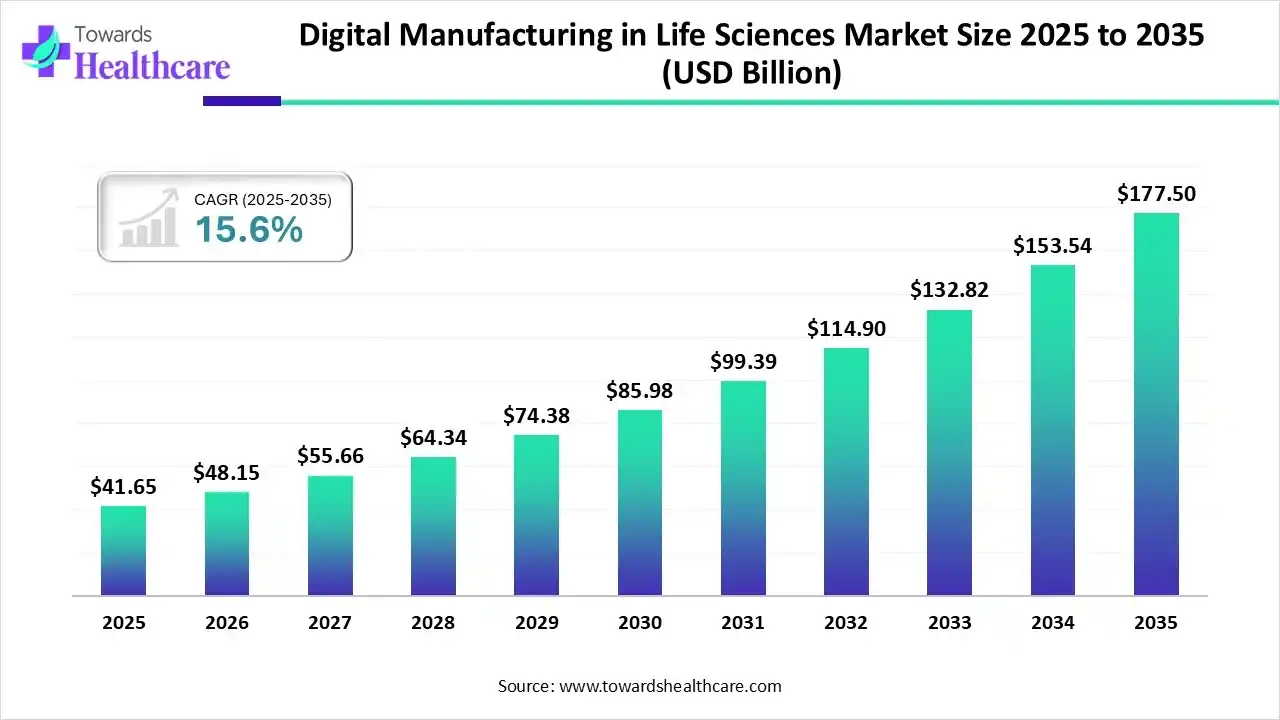
The digital manufacturing in life sciences market is expanding rapidly as more and more biotechnology, pharmaceutical, and medical device companies adopt digital transformation to improve productivity, quality, and compliance. The design, manufacturing, and monitoring of products in the life sciences is being revolutionized by the integration of digital tools like artificial intelligence (AI), robotics, the Industrial Internet of Things (IIoT), and advanced analytics.
| Key Elements | Scope |
| Market Size in 2025 | USD 41.65 Billion |
| Projected Market Size in 2035 | USD 177.5 Billion |
| CAGR (2026 - 2035) | 15.6% |
| Leading Region | North America by 41% |
| Market Segmentation | By Solution, By Application, By Deployment Mode, By End User, By Region |
| Top Key Players | Siemens AG, Dassault Systèmes, Rockwell Automation, Honeywell International, GE Vernova/GE Digital , ABB Ltd., AspenTech , Schneider Electric , AVEVA Group , SAP SE , Veeva Systems, IBM Corporation, Emerson Electric Co., POMSnet (Werum IT Solutions), Thermo Fisher Scientific, Lonza Group AG, Catalent, Inc., Samsung Biologics, Cytiva (Danaher), Amazon Web Services (AWS) Healthcare & Life Science |
Digital manufacturing in life sciences integrates advanced technologies such as automation, artificial intelligence (AI), machine learning (ML), Internet of Things (IoT), digital twins, and cloud computing into pharmaceutical and biotechnology production processes. It aims to streamline operations across R&D, process development, and large-scale manufacturing while ensuring compliance with Good Manufacturing Practices (GMP). Through predictive analytics, real-time monitoring, and process optimization, digital manufacturing improves productivity, product quality, and time-to-market. It is pivotal for biologics, cell & gene therapies, vaccines, and personalized medicines, enabling smart, flexible, and data-driven manufacturing ecosystems.
Which Solution Segment Dominated the Market in 2024?
The manufacturing execution systems (MES) & process automation segment led the digital manufacturing in life sciences market, accounting for approximately 30% of revenue in 2024. Achieving long-term competitive advantages in the life science sector requires MES. They make it possible for plants to be more productive and efficient, as well as for production processes to be more flexible and agile. Furthermore, from experiment delivery to analysis, automated technology is augmenting, or even performing, a wide range of tasks in the life sciences.
AI, ML, and Digital Twin Platforms
The AI, ML, and digital twin platforms segment is anticipated to witness the highest growth in the digital manufacturing in life sciences market during the forecast period. Top companies are adopting generative AI, a potent subset of AI particularly well-suited to this industry because it can analyze extensive datasets on pharmaceutical manufacturing processes and quality control. Machine learning in manufacturing employs sophisticated algorithms to examine large volumes of production data, thereby improving efficiency and precision. Moreover, digital twins can rapidly optimize manufacturing processes, leading to more robust, sustainable global supply chains.
Process Analytical Technology (PAT) & Real-Time Monitoring
The process analytical technology (PAT) & real-time monitoring segment is growing significantly in the digital manufacturing in life sciences market during the studied period. By enabling real-time process monitoring, automation, and faster problem-solving, PAT in CPV guarantees product quality. By giving control and understanding through ongoing data collection, this results in stable product quality, optimized manufacturing, and shortened production times. Real-time process monitoring is managed by the PAT tool. This optimizes quality assurance while reducing the costs and time required to produce high-quality pharmaceuticals.
How the On-Premises Segment Became Dominant in the Market in 2024?
The on-premises segment led the digital manufacturing in life sciences market, accounting for approximately 50% of revenue in 2024. From improved security to cost predictability, on-premises software provides a host of strategic benefits. They give businesses complete control over their systems and data. These solutions offer adaptable choices to meet particular operational and regulatory requirements.
Public Cloud/Saas
The public cloud/SaaS segment is anticipated to witness the highest growth in the digital manufacturing in life sciences market during the forecast period. Businesses in the life sciences can close this data, infrastructure, and intelligence (DII) gap with the aid of SaaS and cloud computing solutions. SaaS and cloud solutions offer a strong option for life sciences organizations to overcome the challenges of updating legacy systems and modernizing their infrastructure in a timely, resource-efficient manner.
Hybrid Cloud Solutions
The hybrid cloud solutions segment is growing significantly in the market during the studied period. Hybrid cloud and integration services have become essential tools for managing the challenges of operational efficiency and regulatory compliance in the regulated life sciences industry. These technologies enable businesses to improve data security, scalability, and flexibility, which promotes innovation while meeting strict compliance standards.
Which End-User Dominated the Market in 2024?
The large pharmaceutical companies segment led the digital manufacturing in life sciences market, accounting for approximately 44% of revenue in 2024. Pharmaceutical companies like Pfizer, Johnson & Johnson, and Novartis are spearheading digital transformation to improve production efficiency and uphold compliance, which is crucial for guaranteeing patient safety, product quality, and business success.
Biotechnology Startups
The biotechnology startups segment is expected to grow at the fastest CAGR during the forecast period. Biotechnology is currently and will continue to be impacted by technological advancements. Modern biotech tools are being used by forward-thinking businesses to boost productivity and expansion. Cloud computing, machine learning, artificial intelligence, and other next-generation computing tools are among the developments anticipated to significantly affect biotechnology manufacturing processes now and in the future.
Contract Development & Manufacturing Organizations (CDMOs)
The contract development & manufacturing organizations (CDMOs) segment is growing significantly in the digital manufacturing in life sciences market during the studied period. In addition to managing various facets of the product development process, CDMOs help businesses meet legal and commercial scalability requirements. They manage far more than just outsourced manufacturing; they can also be involved in product development and collaboration that takes place prior to production.
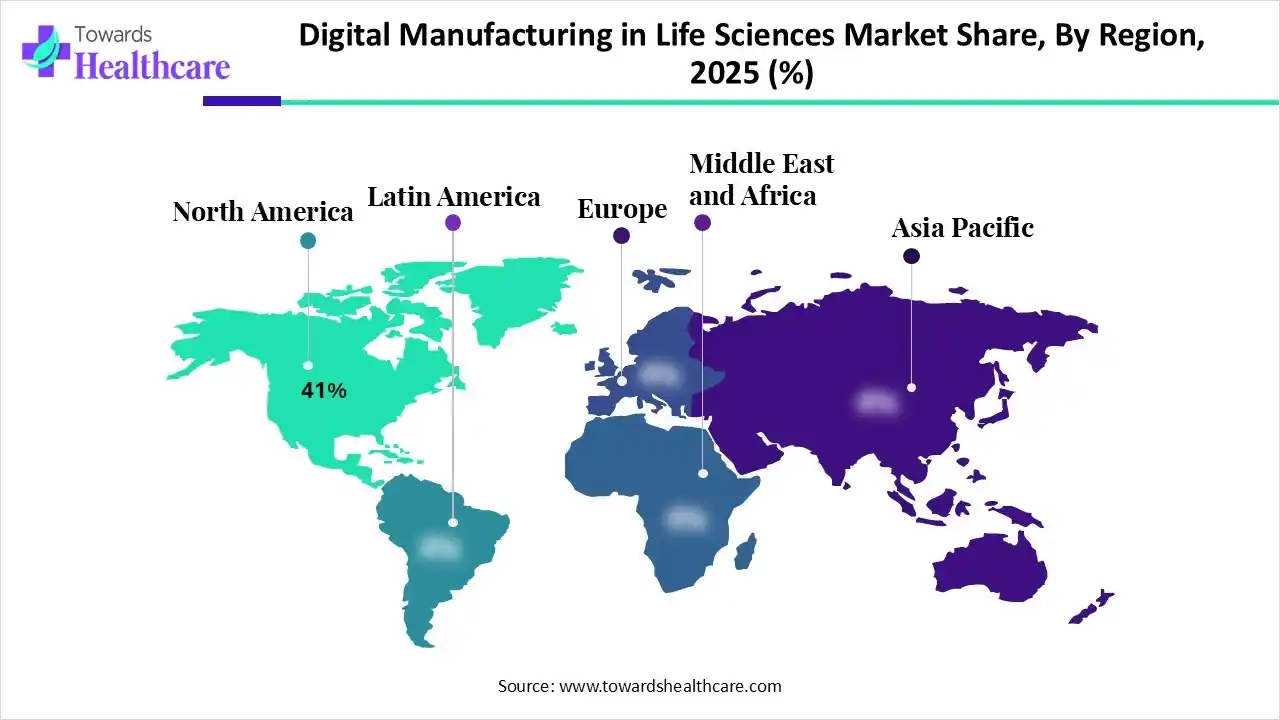
North America dominated the digital manufacturing in life sciences market share by 41%, accounting for approximately 41% of revenue in 2024, propelled by the substantial presence of top biotechnology, pharmaceutical, and medical device firms, as well as by sophisticated digital infrastructure and substantial R&D expenditures. To guarantee product quality and compliance, the region's well-established regulatory framework promotes innovation and the use of Industry 4.0 technologies.
In addition to human health and knowledge of the natural world, the U.S. life science research mission is essential to food production and agriculture, technological advancements, socioeconomic development, national defense, and global leadership. According to a 2025 Research!America survey, 92% of respondents favor the government actively advancing medical science, in part by providing funding for chronic and infectious diseases.
Asia Pacific is estimated to host the fastest-growing digital manufacturing in life sciences market during the forecast period. Among the top nations with the most life sciences companies are China and Japan. Major life science firms are also investing and forming partnerships in developing countries such as Singapore, Japan, and India to broaden their business portfolios and introduce new technologies into the pharmaceutical industries there.
To become the world's leading bioeconomy by 2030, Japan developed a "Bio-Strategy" in 2019. Based on current domestic and global trends, the "Bioeconomy Strategy" was updated in 2024 to reflect the direction of science, technology, and innovation policies aimed at growing the bioeconomy market by 2030. In addition, a substantial budget of roughly 1 trillion yen has been set aside under the Bio-Stegy to support technology development and demonstration in 2024.
Europe is expected to grow at a significant CAGR in the digital manufacturing in life sciences market during the forecast period, backed by a thriving biopharmaceutical industry, reputable research institutions, and substantial government funding. Leading nations in the adoption of cutting-edge technologies for cell biology, proteomics, and genomics research include Germany, the United Kingdom, and France. Europe's focus on digital health and sustainability enhances its standing in the dynamic global life science tools market.
With strong government support and a promising future, the healthcare and life sciences sectors are among the eight strategic growth sectors in the UK's Modern Industrial Strategy. The UK is Europe's top location for life sciences investment, offering a thriving industry with world-class research, a well-connected ecosystem, highly qualified personnel, and a close partnership with the National Health Service (NHS) for foreign investors. For ambitious life sciences companies, the UK is the perfect location because it successfully links investors with clients, partners, and cutting-edge innovation in a competitive business environment.
South America is expected to grow significantly in the digital manufacturing in life sciences market during the forecast period. South America’s life science manufacturers adopt digital manufacturing platforms to modernize production, improve traceability, and support biologics scale-up. Regional public and private investments in AI and infrastructure accelerated in 2024 and 2025, fueling transformative projects and cross-border research partnerships.
Brazilian Biotech Momentum
Brazil pushes AI and pharma manufacturing investment with a 23 billion reais AI plan announced in 2024 and targeted public support for industrial modernization. Local firms and multinationals accelerate digitalization and smart factory pilots across major regional life science hubs
The Middle East and Africa are expected to grow at a lucrative CAGR in the digital manufacturing in life sciences market during the forecast period. MEA life sciences embrace digital manufacturing to expand capacity, diagnostics, and clinical research. Governments increased R&D funding and infrastructure investments in 2024 while private players deploy AI-enabled quality systems, automation, and cloud-based production tools to enhance competitiveness.
Gulf Smart Factory Surge
GCC states scale digital manufacturing in life sciences through national innovation programs, biotech manufacturing projects, and industrial incentives. Saudi and UAE funds and biotech investment vehicles in 2024 and 2025 accelerated capacity building and technology partnerships across regional facilities.
Company Overview
Siemens AG: A global industrial technology company that provides automation, digitalization, and digital manufacturing solutions across industries, including life sciences.
Corporate Information
History and Background
Key Milestones/Timeline
Business Overview
Geographic Presence
Key Offerings
End-Use Industries Served
Key Developments and Strategic Initiatives
Competitive Positioning
SWOT Analysis
Recent News and Updates
Company Overview
Thermo Fisher Scientific: A leading global provider of laboratory instruments, analytical equipment, reagents, consumables, software, and services to the life-sciences, biopharma, diagnostics, and manufacturing sectors—including digital manufacturing support for life-sciences production.
Corporate Information
History and Background
Key Milestones/Timeline
Business Overview
Geographic Presence
Key Offerings
End-Use Industries Served
Key Developments and Strategic Initiatives
$2 billion U.S. investment over four years, including $1.5 billion for manufacturing and $500 million for R&D
Regulatory Approvals
Core Technologies/Patents
Research & Development Infrastructure
Global R&D centers focusing on biotechnology manufacturing and digital technologies
Innovation Focus Areas
Competitive Positioning
SWOT Analysis
Recent News and Updates
| Company | Offerings | Contributions in Digital Manufacturing in Life Sciences Market |
| Dassault Systèmes | Provides the 3DEXPERIENCE platform, integrating PLM, simulation, and digital twin solutions. | Enables virtual design and process optimization for biotech and pharma manufacturing, improving R&D-to-production efficiency. |
| Rockwell Automation | Offers FactoryTalk, automation hardware, and life sciences MES systems. | Enhances smart manufacturing with integrated control, data, and analytics for pharma production. |
| Honeywell International | Delivers automation, process control, and digital MES platforms. | Supports compliant, data-driven pharmaceutical operations with advanced analytics. |
| GE Vernova/GE Digital | Provides digital twin, Predix software, and manufacturing analytics. | Optimizes production and asset performance in life sciences plants. |
| ABB Ltd. | Offers automation, robotics, and control systems for life sciences. | Improves precision, scalability, and sustainability in manufacturing environments. |
| AspenTech | Develops AI-driven process optimization software and digital twins. | Enhances efficiency, predictive maintenance, and compliance in pharma manufacturing. |
By Solution
By Application
By Deployment Mode
By End User
By Region
Speak with a healthcare analyst about your research, consulting, or platform needs.




 sales@towardshealthcare.com