
Find the Right Market Report
Search thousands of industry reports, market insights, and research studies in one place.
Search thousands of industry reports, market insights, and research studies in one place.
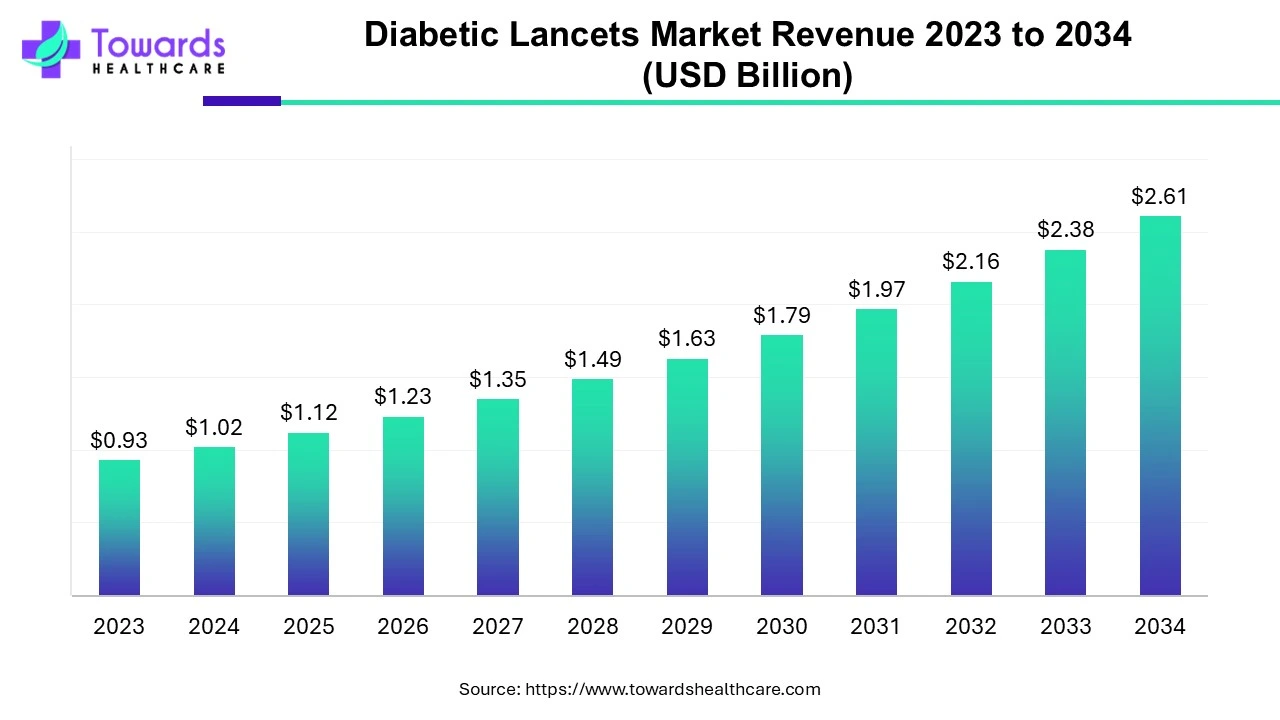
The global diabetic lancets market was estimated at US$ 0.93 billion in 2023 and is projected to grow to US$ 2.61 billion by 2034, rising at a compound annual growth rate (CAGR) of 9.84% from 2024 to 2034. The diabetic lancets market is showcasing dynamic growth and expansion due to rising awareness about diabetes management and regular glucose monitoring, the availability of alternative glucose testing methods and toolkits, and developments in advanced, user-friendly, and pain-free lancet devices.
Diabetes is one of the most common disease concerns among all age groups all over the world. People are becoming more health conscious regarding blood glucose level monitoring to manage diabetes effectively and live healthy and balanced lives. Diabetic lancets are efficient devices that help people accurately and precisely inspect their diabetic levels. Diabetes is a metabolic, chronic disease affecting the heart, kidneys, blood vessels, eyes, and nerves. Type 2 diabetes is the most prevalent, and it has risen in many countries of the world. The prevalence of diabetes is about 422 million people worldwide, including people living in low-and middle-income countries. About 1.5 million diabetic deaths are observed each year.
The growing incidence of diabetes is one of the driving factors for the diabetic lancets market due to the growing adoption of self-monitoring devices and the large number of elderly populations suffering from chronic conditions like diabetes mellitus. The Indian Council of Medical Research India Diabetes Study (ICMR INDIAB) was published in 2023 and reported a prevalence of diabetes of about 10.1 Crores. In March 2024, the Health Science Reports by NIH-NCBI stated that approximately 537 million people were affected with diabetes in 2021 globally. According to the International Diabetes Federation (IDF), diabetes cases will reach up to 783 million by 2045, with an estimated healthcare expenditure of $1054 billion.
Diabetes lancets are small, sterile, single-use devices designed to puncture the fingertip or skin and obtain a blood sample for glucose testing. The track and trace solution makret is growing as manufacturers and healthcare providers seek stronger product identification, supply-chain visibility, inventory management, and protection against counterfeit diagnostic products. Key trends include serialization, QR codes, RFID tagging, smart labels, and cloud-based tracking platforms. Technological advancements in artificial intelligence, IoT, blockchain, and data analysis are enabling real-time monitoring, automated verification, and improved inventory control. Major drivers include rising diabetes screening, growing home-based glucose testing, expanding diagnostic services, stricter product glucose traceability requirements, and increasing demand for efficient recalls. Future opportunities include intelligent packaging, AI-powered demand forecasting, digital authentication, connected inventory systems, and integrated platforms linking manufacturers, distributors, pharmacies, diagnostic laboratories, hospitals, and homecare users for more transparent and efficient product management.
The developing markets in countries like China, India, and Southeast Asia are leading the diabetic lancets market due to their huge patient populations and rising disposable incomes. There are increasing advancements in the design and features of diabetic lancets, such as softer needle tips for reduced pain, automatic release of needles for safe disposal, connectivity features, adjustable depth settings to control puncture depth, etc. Manufacturers are focusing on miniaturization of devices to offer portability and compliance.
According to the reports published by NIH-NCBI in March 2024, half of the people suffering from diabetes (nearly 240 million) are unaware of their medical condition, with the highest rate of undiagnosed diabetes mellitus observed in low- and middle-income countries of Africa, the Western Pacific, and Southeast Asia. The increasing incidence rates of diabetic lancets-related injuries and infections is a global threat because the majority of healthcare workers experience this at least once annually. Infections arising from contaminated lancets are a major concern for both doctors and patients all over the world.
North America dominated the diabetic lancets market in 2023 due to the increase in sedentary lifestyles, limited healthcare access, a dramatic increase in obesity rates, and elderly diabetic population. According to the American Diabetes Association, over 38 million Americans suffer from diabetes, and 1 in 3 adults are considered prediabetic. American Indian and Alaska Native Communities have higher rates of diabetes than other populations. The National Preparedness Report of the United States covers emergency management challenges and the domestic preparedness facing the nation. The estimated annual economic impact of diabetes in the U.S. is $327 billion, along with $237 billion of direct medical costs and $90 billion of indirect medical costs. The average annual cost for patients with only diabetes is $10,100, $5,800 for patients with diabetes and 1-2 other chronic conditions, $11,000 for patients with diabetes and 3-4 other chronic conditions, and $30,100 for patients with diabetes and more than five other chronic conditions.
The National Institute of Diabetes and Digestive and Kidney Diseases (NIDDK) sponsored the Diabetes Prevention Program (DPP) which aims to assess the lifestyle-changing factor of the program and to assess whether metformin would delay or prevent type 2 diabetes mellitus.
U.S. Diabetes Lancets Market Advances Through Home-Based Monitoring
In the U.S., the National Preparedness Report of 2023 was released by the Federal Emergency Management Agency (FEMA), which includes focused discussions on four core capabilities such as public health, healthcare, emergency medical services, logistics and supply chain management, etc.
The U.S. diabetes lancets market is significantly growing due to widespread diabetes screening, increasing self-monitoring of blood glucose, and strong adoption of home-based diagnostic devices. Growing availability of connected glucose meters, established healthcare distribution networks, and increasing preference for convenient testing are supporting demand. Rising awareness of regular glucose monitoring is further encouraging lancet usage among patients managing diabetes.
Canada’s Diabetes Lancets Market Expands with Accessible Diagnostics
Canada’s diabetes lancets market is notably expanding due to increasing diabetes screening, wider availability of primary-care diagnostics, and growing use of self-monitoring devices. Demand is also supported by community-based healthcare services and improved access to portable glucose-testing equipment. Growing awareness of preventive health management and the need for convenient blood-sampling solutions are encouraging greater adoption among patients and healthcare providers.
Asia Pacific is estimated to host the fastest-growing diabetic lancets market during the forecast period due to the growing incidence of diabetes, rising healthcare expenditure, a large patient population, and rising awareness about diabetes management. China, India, and Japan are some of the leading players with their low manufacturing costs and presence of raw material suppliers. These leading manufacturers export their products at affordable costs to other Asian and African countries. The Department of Health and Family Welfare, Government of India, provides financial and technical support to the states under the National Programme for Prevention and Control of Non-Communicable Diseases (NP-NCD) as part of the National Health Mission (NHM) in which diabetes is an integral part of the program. This program aims to strengthen healthcare infrastructure, human resource development, early diagnosis, management, and referral to a suitable healthcare facility for treating non-communicable diseases. It also focuses on health promotion and awareness generation for prevention.
China’s Diabetes Lancets Market Expands with Growing Diagnostic Access
China’s diabetes lancets market is significantly expanding due to increasing diabetes screening, broader healthcare coverage, and growing availability of glucose-monitoring devices. Expansion of community healthcare services and improved diagnostic facilities in developing regions are supporting demand. Rising health awareness, increasing adoption of self-monitoring practices, and strengthening domestic medical-device manufacturing are also improving product availability and encouraging wider use of diabetes lancets.
India’s Diabetes Lancets Market Expands with Rising Diagnostic Awareness
India’s diabetes lancets market is notably expanding due to growing diabetes screening, increasing health awareness, and wider availability of affordable glucose-monitoring devices. Expansion of diagnostic centers and pharmacies into smaller cities is improving accessibility, while rising adoption of home-based testing is supporting regular blood glucose checks. Local manufacturing capabilities and demand for economical healthcare products are further strengthening market opportunities.
By product type, the standard lancets segment led the diabetic lancets market in 2023 due to their convenience and safety features for the patients. They are simple and safe to use and need minimal training. The rising incidence of diabetes, favorable reimbursement policies, increasing healthcare expenditure, and rising awareness about diabetes management have surged the demand and need for standard lancets.
By gauze size, the 17/18g segment led the market in 2023. The 17/18g segment provides a precise balance between painless lancing and adequate blood volume for testing. The 17/18g gauge is improved through clinical use to offer reliable single-stick sampling with reduced pain levels.
By end-use, the hospitals segment led the diabetic lancets market by being potential end users of diabetic lancets due to a large number of patient test cases and compliance requirements. The hospital team precisely monitors the diabetic complications and patient care. The availability of resources in hospitals also encourages safety maintenance as per the biomedical norms.
By Product Type
By Gauge Size
By End User
By Region
Speak with a healthcare analyst about your research, consulting, or platform needs.




 sales@towardshealthcare.com