
Find the Right Market Report
Search thousands of industry reports, market insights, and research studies in one place.
Search thousands of industry reports, market insights, and research studies in one place.
The global dental regeneration market size was estimated at USD 6.85 billion in 2025 and is predicted to increase from USD 7.52 billion in 2026 to approximately USD 17.45 billion by 2035, expanding at a CAGR of 9.8% from 2026 to 2035. A substantial rise in tooth loss & periodontal disease cases is driving the need for advanced dental regeneration approaches. For this, notable efforts called bioprinting, stem cell therapies, and rigorous hybrid materials are fostering the overall market progression.
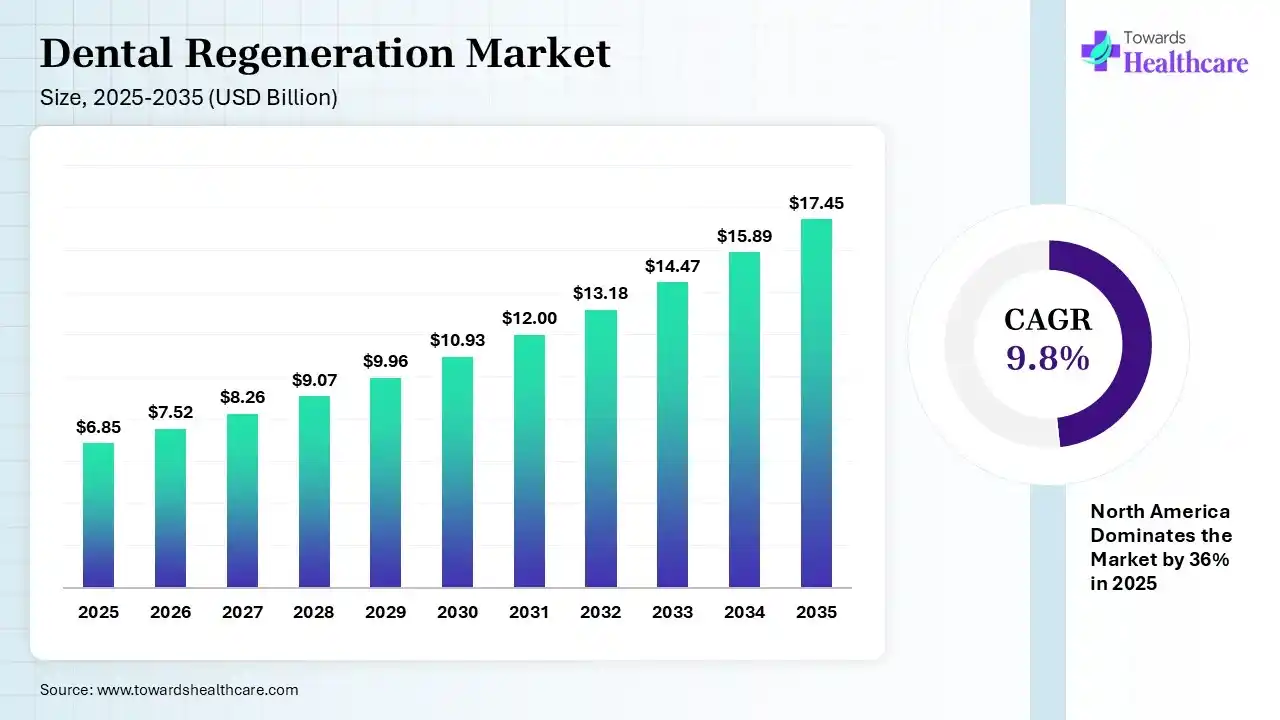
The dental regeneration market is the field of regenerative medicine & dentistry focused on replacing lost or damaged teeth, pulp, or supporting periodontal tissues by stimulating the body's natural regenerative potential. The comprehensive development is propelled by the growing cases of dental concerns, a huge volume of the ageing population that is prone to higher tooth loss, bone resorption, and periodontal disease. Alongside, continuous breakthroughs in enamel matrix proteins, stem cell differentiation, & growth factor delivery are bolstering treatment effectiveness.
Dental regeneration refers to the use of advanced biological therapies, stem cell, biomaterials tissue engineering, and growth factors to restore or regenerate damaged dental tissues, including bone, periodontal ligaments, dental pulp, and gums, instead of simply replacing them.
The dental regenration market is expanding rapidly due to the increasing prevalence of periodontal diseases, tooth loss, and the growing preferences for biologically drive restorative treatments. Technological advancements in stem cell therapy, bioactive scaffolds, 3D bioprinting, and regenerative biomaterials are improving treatment effectiveness and long-term outcomes. Key trends include personalized and the integration of digital dentistry with regenerative technique. Future opportunities lie in gene-based next-generation medicine tissue engineering solutions. Rising investment sin regenerative medicine research, greater patient awareness, and increasing demand for advanced dental care continue to accelerate innovation and global market growth.
A major offering of AI algorithms is to study data to find the rigorous stem cells for particular tissue regeneration, which optimizes their differentiation & survival rates. Moreover, advanced AI & 3D bioprinting are supporting the creation of tailored scaffolds, which meet specific patient defects, & further surges tissue proliferation, with enhanced functional integration. Additionally, the use of artificial neural networks fosters simulation & prediction of cell differentiation & the long-term success of dental tissue regeneration.
Broadening the Use of Stem Cell-Based Therapies
Global researchers are highly utilizing dental-derived stem cells, especially DPSCs, periodontal ligament stem cells (PDLSCs), & SCAP (Stem Cells from Apical Papilla), for their superior ability to categorize into odontoblasts & osteoblasts.
Unveiling Smart & Functional Materials
Gradually, the market is leveraging nanomaterials, including nanohydroxyapatite & bio-responsive hydrogels, which enable the controlled release of growth factors & encourage optimized remineralization & antimicrobial properties.
Surging Bioactive Periodontal Regeneration
The coming research activities will emphasize the evolution of bilayered barrier membranes to actively modulate the immune response & boost bone, cementum, and periodontal ligament regeneration.
| Table | Scope |
| Market Size in 2026 | USD 7.52 Billion |
| Projected Market Size in 2035 | USD 17.45 Billion |
| CAGR (2026 - 2035) | 9.8% |
| Leading Region | North America by 36% |
| Historical Data | 2020 - 2023 |
| Base Year | 2025 |
| Forecast Period | 2026 - 2035 |
| Measurable Values | USD Millions/Units/Volume |
| Market Segmentation | By Product Type, By Application, By Material Type, By End User, By Region |
| Top Key Players | Bioteck S.p.A., Dentsply Sirona, Maxigen Biotech Inc., Institut Straumann AG, Nobel Biocare Services AG (Envista), Geistlich Holding, ZimVie Inc., NovaBone, Osteogenics Biomedical, Regenity |
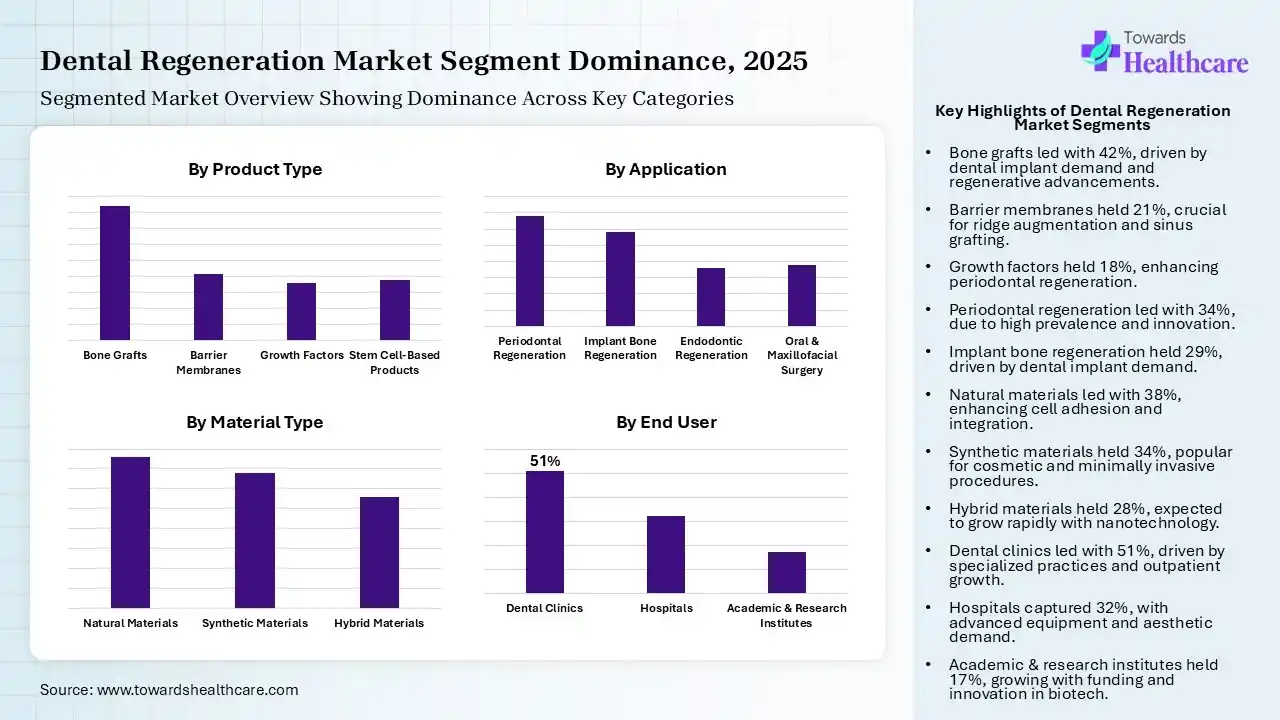
The Bone Grafts Segment Led the Market in 2025
| Segment | Share 2025 (%) |
| Bone Grafts | 42% |
| Barrier Membranes | 21% |
| Growth Factors | 18% |
| Stem Cell-Based Products | 19% |
In 2025, the bone grafts segment dominated with 42% share of the dental regeneration market. A major catalyst is a rise in demand for dental implants as a solution for tooth loss, which is vital to bolster structural support. The trend is following advances in dentine grafts, ion-doped bioceramics, customised, less invasive regenerative solutions & growth factor-enriched scaffolds that elevate regeneration & speed up healing.
The barrier membranes segment held the second-largest share of 21% in 2025, due to the robust application in alveolar ridge augmentation, dental implant socket preservation, periodontal defect treatment, & sinus grafting. The globe is pioneering biomaterials, like bioactive and smart membranes, which promote tissue growth and enhance clinical results.
The stem cell-based products segment captured 19% share in 2025. This covers Dental Pulp Stem Cells (DPSCs), SHED, & SCAP with advanced hydrogel scaffolds and 3D bioprinting, to fulfil the increasing demand for aesthetic dentistry & rising cases of periodontal diseases. The market is leveraging cell-free, MSC-derived exosomes to stimulate bone repair & lower inflammation.
Moreover, the growth factors segment held 18% share of the dental regeneration market in 2025 & is predicted to expand at 10.6% CAGR. The most significant include rhPDGF-BB & rhFGF-2, which support periodontal regeneration to restore bone, cementum, & ligament harmed by disease. Whereas, novel, second-generation platelet concentrate is facilitating a denser, high-viscosity fibrin matrix rich in GFs.
The Periodontal Regeneration Segment Was Dominant in the Market in 2025
| Segment | Share 2025 (%) |
| Bone Grafts | 42% |
| Barrier Membranes | 21% |
| Growth Factors | 18% |
| Stem Cell-Based Products | 19% |
The periodontal regeneration segment held 34% share of the dental regeneration market in 2025. As per one study, the project should be nearly 89.6 million new cases in 2025, which fosters innovations, like growth factors, bone morphogenetic proteins (BMPs) & enamel matrix derivatives (EMDs). Key developments comprise third-generation smart membranes, injectable, self-healing, & piezoelectric hydrogels, etc., for extensive tissue regeneration.
Although the implant bone regeneration segment captured 29% share in 2025, & it is estimated to expand at 10.3% CAGR. This is driven by a rise in the need for stable, long-term dental implants, which require bone augmentation to repair alveolar ridge defects. Notable efforts push 2D titanium carbide (MXene) nanosheets & UHAPNWs for expanded, bioactive, antibacterial membranes.
The oral & maxillofacial surgery segment accounted for 19% share in 2025, due to the surging demand for reconstructive surgery to highlight trauma, congenital anomalies, & tumor removal. Also, substantial advances, like virtual surgical planning (VSP), 3D-printed patient-specific implants/guides, robotic-assisted procedures, & regenerative tissue engineering, impact the overall progression.
The endodontic regeneration segment captured 18% share, due to the step toward pulp preservation, which raises procedures, with advances in regenerative endodontics to enhance outcomes.
The Natural Materials Segment Led the Market in 2025
| Segment | Share 2025 (%) |
| Natural Materials | 38% |
| Synthetic Materials | 34% |
| Hybrid Materials | 28% |
In 2025, the natural materials segment held a major share of 38% of the dental regeneration market. Their adoption offers mimicking of the extracellular matrix (ECM), growth of superior cell adhesion, proliferation, & integration. Studies are exploring the integration of natural polymers with stem cells to design patient-specific scaffolds for a precise match to defect anatomy.
The synthetic materials segment held the second-largest share of 34% in 2025. These are actively used in accelerating cosmetic dental procedures, & the demand for minimally invasive solutions. Moreover, researchers are uniting synthetic polymers like PCL or PLGA with bioactive ceramics to mimic bone’s mechanical characteristics.
However, the hybrid materials segment held 28% share in 2025 & is anticipated to expand rapidly at 10.8% CAGR. The market is shifting towards resin-infiltrated ceramics, bioactive glasses, or polymer-filled scaffolds, & also transforming nanotechnology, which bolsters regenerative effectiveness.
The Dental Clinics Segment Dominated the Market in 2025
| Segment | Share 2025 (%) |
| Dental Clinics | 51% |
| Hospitals | 32% |
| Academic & Research Institutes | 17% |
The dental clinics segment accounted for 51% share of the dental regeneration market in 2025. This dominance is specifically fueled by specialized periodontal & implantology practices, which are prominent venues for tissue regeneration, bone grafting, & implant-site development. Also, the worldwide increase in outpatient procedures is spurring clinical visits.
The hospitals segment captured 32% revenue share in 2025, due to the presence of advanced equipment, which spurs procedures, & surging healthcare investments to harness growth. They are inclining towards aesthetic outcomes in gum contouring and tooth restoration
The academic & research institutes segment held 17% share in 2025 & is estimated to grow at 10.9% CAGR. Many governments are raising funding to assist innovation & also aligning with biotech firms to promote development. They are playing a pivotal role in impelling translational science, proof-of-concept studies, & clinical trials to guide regulatory approvals.
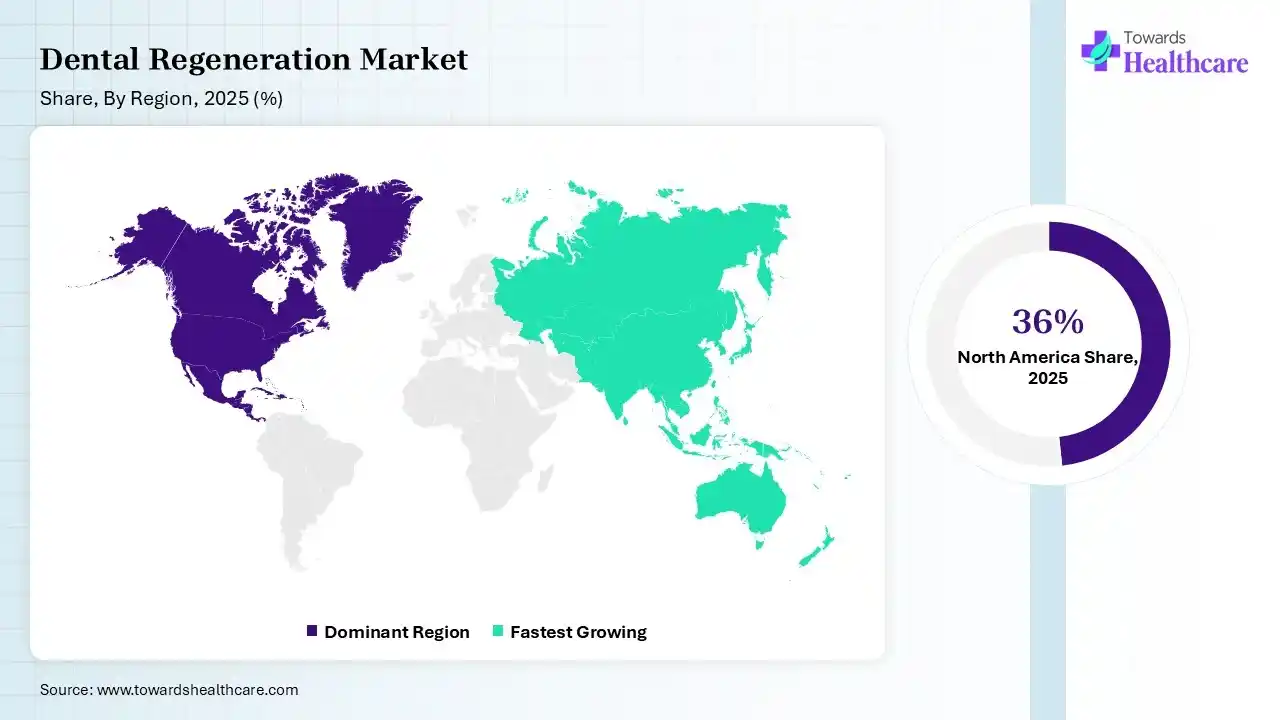
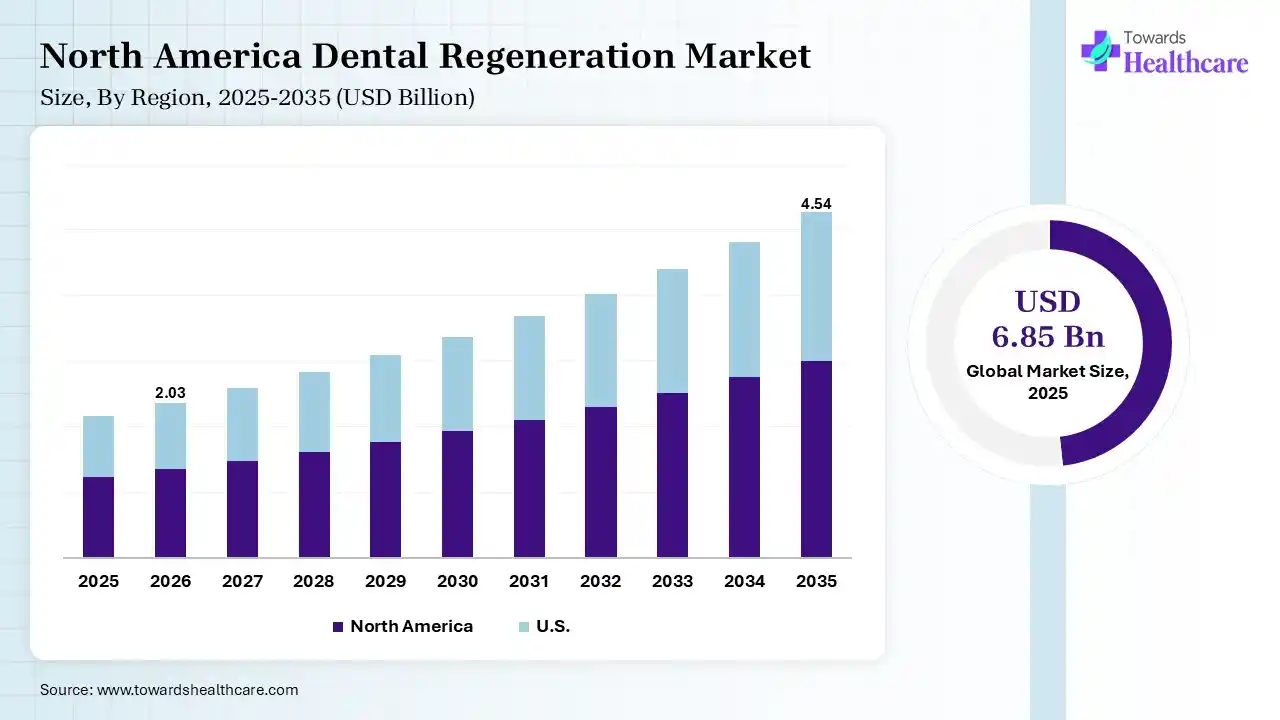
In 2025, North America registered dominance with 36% share in the dental regeneration market due to the well-established healthcare infrastructure & higher dental spending. The regional researchers are widely putting efforts into stem cells, bioengineered materials, and advanced imaging.
For instance,
U.S. Market Trends
Particularly, teams in the US have introduced bioactive, protein-based gels that can repair & regrow damaged enamel by developing remineralization. The U.S. clinical trials are raising the adoption of autologous Dental Pulp Stem Cells (DPSCs) to regenerate vascularized pulp tissue in injured teeth.
Canada Advances Dental Regeneration Through Research and Innovation
The Canada dental regeneration market is growing significantly due to increasing research in regenerative dentistry, strong academic collaborations, and the expanding use of advanced biomaterials in clinical practice. Rising availability for specialized dental care, and continuous innovation in tissue engineering and regenerative technologies are accelerating adoption. Supportive healthcare investments and an aging population further contribute to sustained market growth.
Asia Pacific held 24% of the market share in 2025 and is anticipated to expand fastest at 11.2% CAGR in the dental regeneration market. This has been propelled due to the expanding disposable income across China, India, and South Korea, with extensive medical tourism, especially in India & Thailand, which provides affordable, advanced periodontal & implant interventions.
China Market Trends
Whereas, diverse Chinese studies are demonstrating that injections of allogeneic dental pulp stem cells (hDPSCs) are safe & highly efficacious to treat severe periodontitis, specifically in stage III cases. Also, the adoption of silk fibroin (SF) scaffolds, often modified with RGD sequences, supports the regeneration of dentin, pulp, & periodontal tissues.
India Emerges as a Rapidly Expanding Market for Dental Regeneration
The India dental regeneration market is growing significantly due to the increasing number of dental clinics offering regenerative procedures, rising awareness of advanced oral healthcare, and greater demand for aesthetic and restorative dentistry. Expanding domestic production of dental biomaterials, growing investments in dental education and research, and improved access to specialized treatments are accelerating adoption. Additionally, India’s strong dental tourism industry and increasing preference for regenerative solutions are supporting long-term market growth.
R&D
Clinical Trials & Regulatory Approvals
Patient Support & Services
| Company | Description |
| Bioteck S.p.A. | This offers diverse regenerative solutions for dentistry, mainly based on their proprietary Zymo-Teck enzymatic deantigenation process. |
| Dentsply Sirona | This primarily facilitates the OSSIX product family & the Symbios allograft line. |
| Maxigen Biotech Inc. | Its offerings include collagen-based and synthetic biomaterials to support soft & hard tissue repair. |
| Institut Straumann AG | A firm provides a comprehensive portfolio for dental regeneration, specializes in periodontal regeneration, bone grafting, & soft tissue management. |
| Nobel Biocare Services AG (Envista) | This majorly offers creos xenogain (bone substitute), creos xenoprotect (collagen membrane), & synthetic alternatives to assist Guided Bone (GBR) & Tissue Regeneration (GTR). |
| Geistlich Holding | A company focuses on providing products for guided bone regeneration (GBR), sinus floor elevation, & periodontal treatment. |
| ZimVie Inc. | They have explored Puros Allografts, RegenerOss Xenografts, & advanced barrier membranes. |
| NovaBone | Its portfolio facilitates bioactive synthetic bone graft substitutes. |
| Osteogenics Biomedical | This usually offers non-resorbable PTFE membranes, collagen membranes, allografts, soft tissue products, & fixation systems. |
| Regenity | A firm specializes in bioresorbable and biocompatible products for dental regeneration. |
In April 2026, "Completing enrollment in the RESTORE study is a major achievement that validates the growing clinical interest in our platform, "We are grateful to the investigators, clinical teams, patients, and partners whose dedication made this milestone possible. This achievement strengthens our growing body of clinical evidence and brings us closer to delivering meaningful new treatments for patients with limited options”, said Dr. Luis Alvarez, Founder and CEO of Theradaptive.
Strengths
Weaknesses
Opportunities
Threats
By Product Type
By Application
By Material Type
By End User
By Region
Speak with a healthcare analyst about your research, consulting, or platform needs.




 sales@towardshealthcare.com