
Find the Right Market Report
Search thousands of industry reports, market insights, and research studies in one place.
Search thousands of industry reports, market insights, and research studies in one place.
Date : 05 December 2025
The precision medicine software market is anticipated to grow significantly in the near future due to increased collaboration and licensing agreements between businesses, increased R&D investment in precision medicine, and increased partnerships between research institutions and businesses.
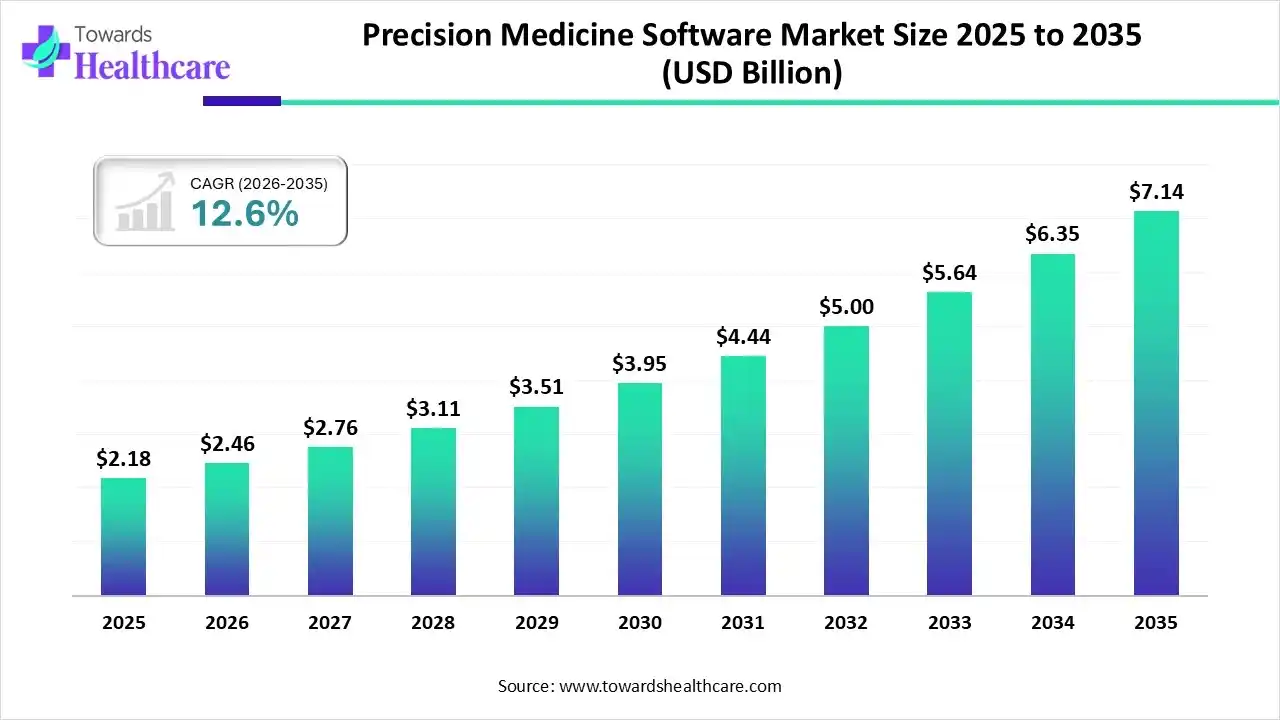
The global precision medicine software market size is calculated at US$ 2.18 billion in 2025, grew to US$ 2.46 billion in 2026, and is projected to reach around US$ 7.14 billion by 2035. The market is expanding at a CAGR of 12.6% between 2026 and 2035.
Key Offering: SOPHiA DDM™ Platform (AI/ML for Multi-Modal Data)
Focus Area: Democratizing data-driven medicine through cloud-based analysis of genomics, radiomics, and clinical data.
Key Offering: GenMedPro™ Precision Medicine Software
Focus Area: Pharmacogenomic (PGx) clinical decision support in psychiatry. Integrates PGx test results with drug–drug interactions.
Key Offering: Health Data Apps & AI, Orchestrated Clinical Trials
Focus Area: Real-world evidence (RWE) and clinical trials. Uses AI for patient stratification and accelerating precision R&D.
Key Offering: Genedata Profiler®
Focus Area: Enterprise multi-omics data integration. Standardizes and harmonizes complex multi-omics datasets for biomarker discovery and translational medicine.
Key Offering: Digital health solutions & custom software development
Focus Area: Custom software and implementation services for genomics data management, LIMS, and clinical trial support.
Company Overview:
Company Overview: A global leader in DNA sequencing and array-based technologies, providing integrated systems for genetic variation and biological function analysis. Its software is crucial for managing and interpreting massive genomic datasets generated by its sequencers, driving the adoption of precision medicine in research and clinical settings.
Corporate Information:
History and Background:
History and Background: Founded by five individuals, including David Walt, to develop high-throughput DNA sequencing and genotyping technologies. Its growth was significantly bolstered by the 2007 acquisition of Solexa, Inc., which brought the foundational next-generation sequencing (NGS) technology to the company, establishing its market dominance.
Key Milestones/Timeline:
Business Overview:
Business Overview: Primary revenue streams include sequencing instruments, consumables (reagents/kits), and informatics/software solutions (e.g., DRAGEN, Illumina Connected Analytics). The focus is on lowering the cost of sequencing and accelerating the adoption of genomic insights into clinical care.
Business Segments/Divisions:
Key Offerings:
End-Use Industries Served:
Key Developments and Strategic Initiatives:
Mergers & Acquisitions:
Recent Focus: Efforts have been largely focused on the complex regulatory-driven divestiture of GRAIL.
Partnerships & Collaborations:
Product Launches/Innovations:
DRAGEN Secondary Analysis v4.4: Latest software update delivers enhanced accuracy, including a 30% improvement in structural variant calling.
Capacity Expansions/Investments:
Continuous investment in R&D to drive down the cost of sequencing and improve software processing speed and accuracy.
Technological Capabilities/R&D Focus:
Core Technologies/Patents:
Competitive Positioning:
Strengths & Differentiators:
SWOT Analysis:
Recent News and Updates:
Press Releases:
Company Overview:
Company Overview: A global technology corporation that, through its acquisition of Cerner, provides a comprehensive portfolio of Electronic Health Record (EHR), clinical, and administrative software, making it a critical player in health data management and precision medicine workflow.
Corporate Information:
History and Background:
History and Background: Oracle is a leading enterprise technology provider known for its database and cloud infrastructure. Its entry into dominant healthcare IT was cemented by the $28 billion acquisition of Cerner in June 2022, creating Oracle Health. This positioned Oracle to integrate patient data from the EHR the largest source of clinical data with genomic and AI platforms to enable precision medicine at the point of care.
Key Milestones/Timeline:
Business Overview: Oracle Health provides EHR systems and a suite of clinical, financial, and population health management solutions. The strategic direction is to leverage Oracle Cloud Infrastructure (OCI) and AI/ML to transform the EHR from a system of record into a system of intelligence that supports personalized medicine.
Business Segments/Divisions:
Key Offerings:
End-Use Industries Served:
Key Developments and Strategic Initiatives:
Mergers & Acquisitions:
2022: Cerner Corporation acquisition, a transformative event for their presence in healthcare IT and precision medicine software.
Partnerships & Collaborations:
Product Launches/Innovations:
Capacity Expansions/Investments:
Significant investment in moving Cerner systems onto the Oracle Cloud Infrastructure (OCI) for improved scalability and data processing for AI/ML.
Technological Capabilities/R&D Focus:
Core Technologies/Patents:
Competitive Positioning:
Strengths & Differentiators:
SWOT Analysis:
Recent News and Updates:
Press Releases:
Partner with our experts to explore the Precision Medicine Software Market at sales@towardshealthcare.com
Speak with a healthcare analyst about your research, consulting, or platform needs.